

Guru
Founder, Vynlox
Most dental practices in Australia spend $3,000 to $6,000 per month on Google Ads chasing patients while their SEO sits broken in the background. They rank on page 3 for their own suburb. Their Google Business Profile has not been touched in two years. New patients find them through luck, referrals, or paid clicks that stop the moment the budget runs out.
That is a problem. It is also an opportunity. Dental SEO done right gives a practice a steady stream of new patients without the per-click bleed of paid search. The patients who find you through organic Google are higher intent, lower cost to acquire, and they tend to stick around because they searched for you instead of being interrupted by you.
This guide walks through everything an Australian dental practice needs to know to win local search in 2026. If you would rather skip the DIY and have us handle the whole thing, our SEO retainer for dental practices runs the full playbook for you.
Free SEO audit · No obligation
Curious how your site ranks today?
We'll audit your current SEO, identify the biggest opportunities, and send the report. Free, no obligation.
Get a Free SEO AuditWhat dental SEO actually is
Dental SEO is the work of making your practice the obvious result when someone in your suburb searches for "dentist near me", "[suburb] dentist", "teeth whitening [suburb]", or any of the hundreds of treatment terms a potential patient might type into Google or ask their phone.
It splits into three layers:
- Local SEO. How you appear in the Google Map pack and Google Business Profile results. This is the most important layer for new-patient acquisition.
- On-page SEO. How your practice website is built, written, and structured. This determines whether you show up in search at all and whether the visit converts to a booking.
- Authority and trust signals. Links from other websites, reviews, citations across directories, and content that makes Google trust you as a real business.
Most practices fail at all three. The good news is that fixing these is mechanical, repeatable work, and the dental search market in Australia is far less competitive than finance, law, or property.
Why dental practices need SEO in 2026
Three things have changed in the last 18 months that make dental SEO more valuable than ever for Australian practices.
First, Google Ads costs have climbed sharply. The average cost per click for "dentist [city]" terms in Australia now sits between $8 and $25 depending on the city and treatment type. Practices that used to acquire a patient for $80 are now paying $200 or more, and the trend is up not down.
Second, Google has rolled out AI Overviews and Search Generative Experience for health-adjacent queries. When someone asks Google "do I need a crown after a root canal" or "best dentist in [suburb]", they often see an AI-generated answer at the top of the results that cites specific websites. If your site is not optimised to be cited, your competitor''s is. We cover this in our Answer Engine Optimisation guide, and it is becoming as important as traditional SEO for healthcare practices.
Third, voice search and mobile-first indexing mean patients increasingly find dental practices by saying "OK Google, find me a dentist open now". Your practice either appears in those results or it does not, and the deciding factor is your local SEO foundation.
The combined effect: practices with strong organic search positions are spending less to acquire new patients while their competitors burn cash on paid ads. The gap widens every quarter.

The dental SEO playbook
Here is what actually moves the needle, in priority order.
1. Google Business Profile (the single biggest lever)
If you do nothing else from this guide, do this. Your Google Business Profile is the single largest contributor to new patient enquiries from search.
The non-negotiable basics:
- Verified profile claimed by the practice owner
- Primary category set to "Dentist" (not "Medical clinic" or "Health")
- Secondary categories for any specialties (Cosmetic dentist, Orthodontist, etc.)
- All practice photos uploaded (exterior, interior, treatment rooms, team) with current dates
- Hours, including holiday hours, kept up to date
- Phone number that goes to a real person during opening hours, not voicemail
- Website link pointing to a dedicated location page on your site, not the homepage if you have multiple locations
- Description with primary keyword in the first sentence ("Dentist in [suburb]" or similar)
- Services list populated with every treatment you offer
- Q&A section seeded with the questions patients actually ask, answered by the practice
After the basics are right, you start posting. Google Business Profile posts are weekly content (treatment offers, team news, patient education) that signal an active business. Practices that post weekly outrank practices that do not, all else being equal.
We cover the full local SEO playbook on our local SEO Sydney page, and it applies to dental practices in any Australian city.
2. NAP consistency and local citations
NAP stands for Name, Address, Phone. It needs to be identical everywhere your practice is listed online: your website, Google Business Profile, Healthengine, Whitecoat, True Local, Yellow Pages, Facebook, every directory.
Inconsistent NAP is the silent killer of local SEO for dental practices. Google sees three different phone numbers for "Smith Dental Castle Hill" across four directories and quietly downranks the practice because it is not sure which entity is real.
Run a NAP audit by searching Google for your phone number and address. Every mismatch you find gets fixed.
3. Reviews strategy
Reviews drive two things: Google ranking and click-through rate. Practices with 100+ reviews and a 4.7+ star average get more clicks from the same Map pack position than practices with 30 reviews and a 4.5 star average.
A practical reviews system for a dental practice:
- Train every reception team member to ask for a review at checkout when the patient says they are happy
- Send a follow-up SMS the same day with a direct link to your Google review form, not a generic page
- Reply to every review, positive and negative, within 48 hours
- Use a QR code at reception that links straight to the review form
- Never buy reviews or use a third-party service that drips fake reviews. Google detects this within weeks and the penalty is brutal.
Aim to add 5 to 10 genuine reviews per month. That is a sustainable pace that will not trigger Google''s spam filters and will compound over time.
4. Treatment pages that convert
Most dental websites have one page per service: "Cosmetic Dentistry", "Orthodontics", "Dental Implants". This is fine for navigation but useless for SEO.
The pages that actually rank and convert are deeper:
- "Dental Implants [Suburb]" with pricing range, finance options, before/after gallery
- "Invisalign [Suburb]" with treatment timeline, comparison to braces, FAQ
- "Emergency Dentist [Suburb]" with same-day appointment policy, after-hours contact
- "Teeth Whitening [Suburb]" with in-chair vs at-home comparison, costs
Each treatment page targets a high-intent search and addresses the specific questions a patient at that decision stage actually has. If your site does not have these, your competitors do, and they are catching the patients before you.
Our website design service builds treatment pages that rank and convert. For practices that already have a site, we audit it as part of a free Growth Diagnostic and tell you exactly which pages to add or rewrite first.
5. Technical SEO foundation
The technical basics every dental practice site needs:
- HTTPS on every page (no exceptions, this is 2026)
- Mobile page speed under 2.5 seconds on a 4G connection
- Schema markup: Dentist, MedicalBusiness, LocalBusiness, FAQ schema where appropriate
- Clean URL structure: /implants, not /services?id=347
- XML sitemap submitted to Google Search Console
- Robots.txt that does not accidentally block treatment pages
Most dental practice sites built on platforms like Wix or generic templates get the basics right. The ones that struggle are usually built by a friend''s agency in 2018 and have not been touched since.
6. Content that builds topical authority
Treatment pages capture commercial searches. Educational content captures informational searches and builds Google''s trust in your practice as a credible source.
The content that works for dental practices:
- "How long does a [treatment] take" answered honestly with timeline
- "Cost of [treatment] in Australia" with realistic price ranges
- "[Treatment] vs [alternative]" comparisons (Invisalign vs braces, crowns vs veneers)
- Patient stories in long form (with consent), not just before and after photos
- Local content: events you sponsored, community involvement, awards
You do not need to publish weekly. One thorough article per month, properly internally linked, builds more topical authority than four thin pieces.

How dental SEO compares to other channels
| Channel | Time to first results | Cost trajectory | Quality of patients |
|---|---|---|---|
| Google Ads | 1 to 2 weeks | Linear with spend | Mixed, depends on landing page |
| SEO (local + on-page) | 3 to 6 months | Fixed, asset compounds | High, search intent matched |
| Healthengine / Whitecoat | Immediate | Per-booking fee, ongoing | Variable, price-shoppers |
| Social media ads | 1 to 4 weeks | Linear with spend | Lower intent, top-of-funnel |
| Referrals | Years to build | Free after acquisition | Highest |
The right answer for most practices is a combination, weighted toward SEO over time. Ads are tactical (turn on when you have capacity), SEO is strategic (builds an asset over years). Healthengine fills gaps but does not build your practice''s brand.
How to measure dental SEO results
Three metrics matter and one matters above all.
The one that matters most: new patient enquiries that came from organic search. Set up call tracking with a unique phone number on your Google Business Profile and a different one on your website. Every enquiry should be tagged at source. If you cannot tell which channel brought a patient in, you cannot optimise it.
Supporting metrics:
- Map pack rankings for your top 5 search terms (track weekly)
- Organic traffic from Google Search Console (track monthly)
- Click-through rate on your top ranking pages (low CTR with high impressions means weak titles or meta descriptions)
- Time on page and bounce rate for treatment pages (low time on page means the content is not matching intent)
Reviews and Google Business Profile insights round out the picture. We pull all of this into a monthly dashboard for retainer clients, but you can do it yourself with free tools if you have the time.
Common dental SEO mistakes
After auditing dozens of dental practice websites, the same mistakes show up again and again:
- Multiple practice locations sharing one Google Business Profile. Each location needs its own. This is non-negotiable.
- Generic homepage trying to rank for everything. Will not work. Build dedicated treatment pages.
- Buying reviews or running review-gating schemes. Detected by Google within weeks. Permanent damage.
- Hiding pricing. Patients searching for cosmetic treatments want price ranges. Pages that hide pricing convert worse than pages that do not.
- No local content. A "Dentist [Suburb]" page that has no reference to the actual suburb (street names, landmarks, local context) reads like every other dentist site to Google.
- Stale content. A blog with the last post from 2022 signals an inactive business. Either commit to monthly content or delete the blog page entirely.
- Treatment pages without FAQs. Patients have specific questions. Pages without FAQ sections lose the SERP feature and rank worse.
We see all of these so often we built a free Growth Diagnostic that flags every one of these issues on a practice''s site in under 24 hours.

How long dental SEO takes to work
Realistic timeline for an Australian dental practice starting from scratch:
- Month 1. Foundation work. Google Business Profile fix, NAP audit, technical SEO basics, schema markup. Patients will not notice changes yet.
- Months 2 to 3. First Map pack movement. Treatment pages start indexing and ranking for low-difficulty terms. First trickle of new patients from organic.
- Months 4 to 6. Map pack consistency for primary terms (dentist [suburb]). Treatment pages ranking for secondary terms. Reviews compounding. Measurable lift in new patient enquiries.
- Months 6 to 12. Topical authority kicking in. Treatment pages dominating local SERPs. Organic now a meaningful share of new patients. Less reliance on ads.
If you are being told dental SEO works in 30 days, you are being sold to. If you are told it never works, you are being sold to by an ads agency. The truth sits in the middle.
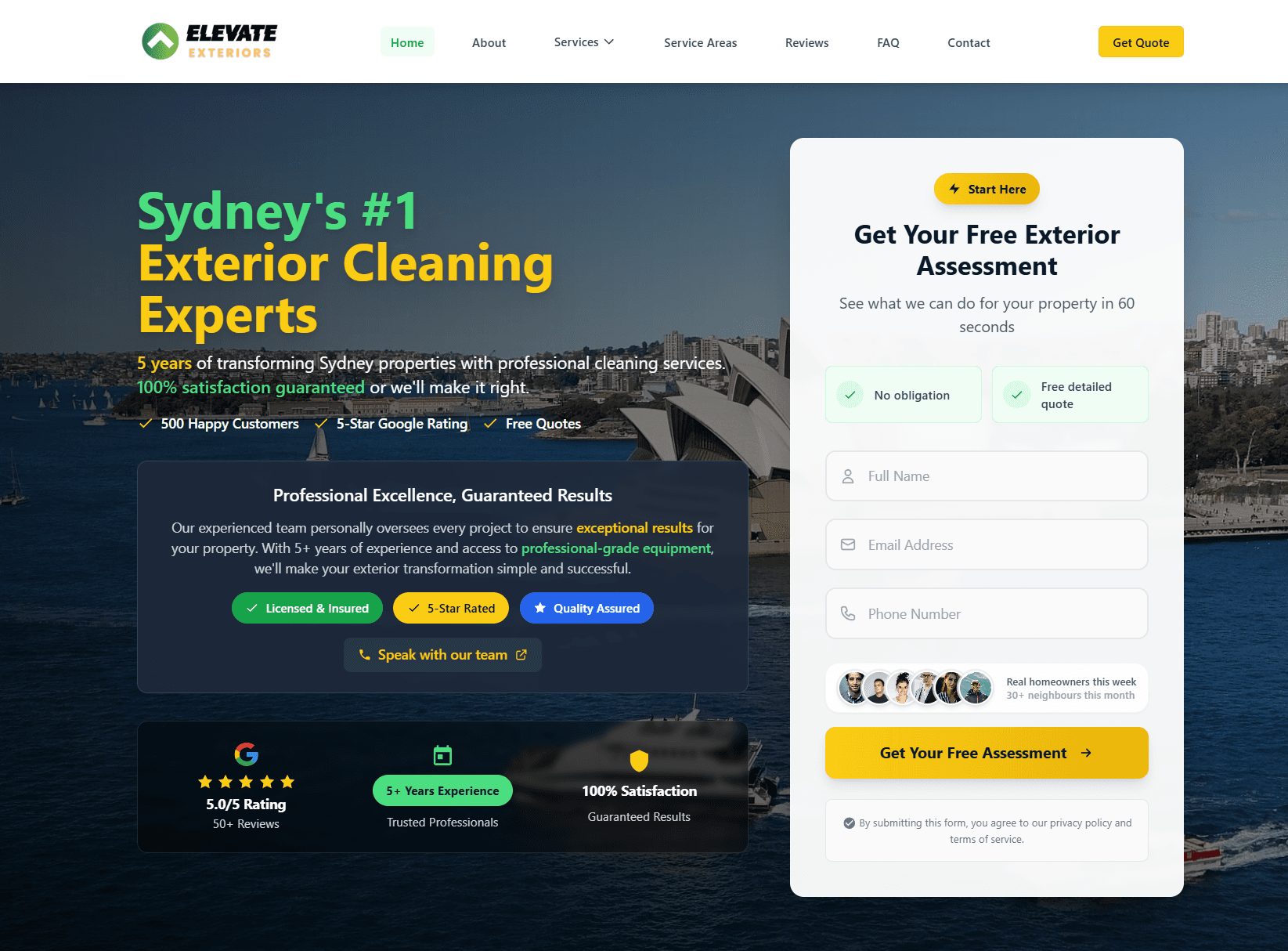
Real client. Real results.
Elevate ExteriorsExterior Services
Website rebuild + SEO foundations. After a 4 to 6 month build phase, now generating 15 to 20 qualified leads per month from organic search. No ad spend, lead quality consistently higher than paid traffic.
Quick answers
Frequently asked questions
Tagged with
Written by
Guru, Founder at Vynlox
Sydney based · 8+ years building websites · 100% client retention
I started Vynlox after watching too many good Australian businesses get burned by agencies that send reports, not results. Every strategy call you book is with me directly. You won't be handed off to a junior. You work with me.


