

Guru
Founder, Vynlox
If you have read enough marketing blogs you have been told a version of the same answer: "It depends, run both, here is some content padding." That is half right and half nonsense. The real answer is more nuanced and depends on your time horizon, your margin per customer, the channel maturity in your niche, and whether you can survive 6 months without the leads SEO eventually produces.
Here is the real comparison, with the parts most articles skip. If you want this answered for your specific business, request a free proposal and we will tell you which channel(s) to invest in first.
The 10-second answer
Free SEO audit · No obligation
Curious how your site ranks today?
We'll audit your current SEO, identify the biggest opportunities, and send the report. Free, no obligation.
Get a Free SEO AuditGoogle Ads gives you traffic on day one and stops the moment your budget runs out. SEO takes 3 to 6 months to ramp and then compounds for years. Run both for the first 6 months, then taper paid as organic takes over. Skip this advice if your margin is too thin to support a $2,500+ a month retainer for 6 months without producing immediate leads. In that case, run Ads only.
That is the honest version. Now here is the longer one.
What SEO and Google Ads actually are
SEO is the work of getting your site to rank in Google's organic results when customers search for what you offer. It includes technical fixes, content, on-page optimisation, link building, schema, and Google Business Profile. The investment is mostly people-time and tooling. The return is a compounding asset: rankings stay (with maintenance), the traffic keeps coming, the cost per lead falls over time.
Google Ads is paid placement. You bid on keywords, your ad shows above (and sometimes below) the organic results, and you pay per click. The investment is direct ad spend plus management. The return is immediate: clicks today, leads this week, predictable cost per lead. The trade-off is durability: stop paying, traffic stops.

Where SEO wins
SEO wins on cost trajectory, lead durability, and lead quality. By month 12 of a properly-run SEO program, the cost per lead from organic is a small fraction of the cost per lead from Google Ads. We saw this with RyRo Loan Centre (visit them at ryroloancentre.com.au): zero ad spend, 22 qualified leads in 90 days, then a steady-state floor of 15 to 20 qualified leads per month, climbing as authority compounds. Organic + GBP + AI search referrals carried the load. Their close rate on organic leads was higher too, because the customer chose them rather than being matched by an algorithm.
SEO also wins on lead quality. People who found you in organic search did so because their query matched your content. They have already pre-qualified themselves. People who clicked an ad did so because Google's targeting algorithm matched them to your campaign. The intent ladder is steeper for organic.
The third win is durability. The week you stop your SEO retainer, you keep most of your rankings for months. The week you stop your Google Ads campaign, you lose all of that traffic the same day.
Where Google Ads wins
Google Ads wins on speed, control, and certainty. You can be running ads tonight, generating clicks tomorrow, and have leads booked by end of week. SEO cannot match that.
Ads also win on testing. Want to see if a new service offering generates demand? Run an ad for two weeks. Want to see if "fast" or "affordable" converts better in your market? Test both ads against each other. SEO is a 3 to 6 month commitment per page; Ads test ideas in days.
Ads win on geographic precision too. You can target a 5km radius around a specific suburb, only show ads in business hours, exclude certain postcodes. Local SEO covers your service area, but you cannot dial it as precisely as paid.
Finally, Ads win in mature, saturated SERPs where organic is dominated by DR-70+ sites you have no realistic chance of outranking inside 18 months. In those cases, paid is the pragmatic answer.
Side-by-side comparison
| Factor | SEO | Google Ads |
|---|---|---|
| Time to first lead | 3 to 6 months | Day one |
| Cost trajectory | Falls over 12 to 24 months | Stays high or rises with competition |
| What you own after 12 months | Rankings, traffic, asset | Nothing |
| Lead quality | Higher (self-qualified search intent) | Mixed (algorithm-matched) |
| Geographic precision | Service-area level | Postcode / 5km radius |
| Best for | Stable growth, defensible asset | Fill gaps, urgent jobs, testing |
| Risk if you stop | Slow decay over months | Immediate, complete |
| Initial cost | $1,500 to $5,000+ a month retainer | Variable, $1,000+ a month + management |
The math by month 18: a $2,500 a month SEO retainer producing 20 qualified leads is $125 per lead. A Google Ads campaign in a competitive Australian niche routinely costs $300 to $1,500 per qualified lead. The asset wins on cost over the long run.
When SEO wins, when Ads win, when both win
SEO is the right primary channel when:
- You have 6+ months of runway. Real runway, not "let us see how this goes".
- Your customers Google your service with commercial intent. Most Australian local service businesses qualify.
- Your margin per customer can support a $2,000 to $5,000 a month retainer for 6 months without leads.
- You want a defensible long-term asset. Bigger competitors cannot outspend you on rankings, only outwork you.
Google Ads is the right primary channel when:
- You need leads this month. SEO cannot help; Ads can.
- Your niche has shallow demand and DR-70+ sites dominate organic. Paid is your realistic path.
- You are validating a new offer. Use Ads to test demand before committing to 6 months of SEO build.
- You are filling a seasonal peak (e.g., emergency plumbing in storm season). Ramp Ads, not SEO.
Both channels at once is the right answer when:
- You have growth ambition and 12+ months of runway. Run Ads to fill the pipeline while SEO builds. Taper Ads as organic compounds.
- You are in a competitive vertical (legal, finance, dental, exterior services). The combined three-channel approach (organic + paid + AI search) outperforms any single channel.
This is the approach we use across our website design + SEO retainer engagements. The same logic plays out in our complete dental SEO guide and our SEO playbook for plumbers.

How to actually compare them in your own business
Use this spreadsheet (or napkin math):
- Calculate your cost per qualified lead from each channel separately. Total spend divided by qualified leads.
- Calculate your close rate from each channel. Closes divided by qualified leads.
- Calculate your cost per closed customer. Cost per lead divided by close rate.
- Compare cost per closed customer against your customer LTV. If cost per close is more than 30 percent of LTV, the channel is too expensive long-term.
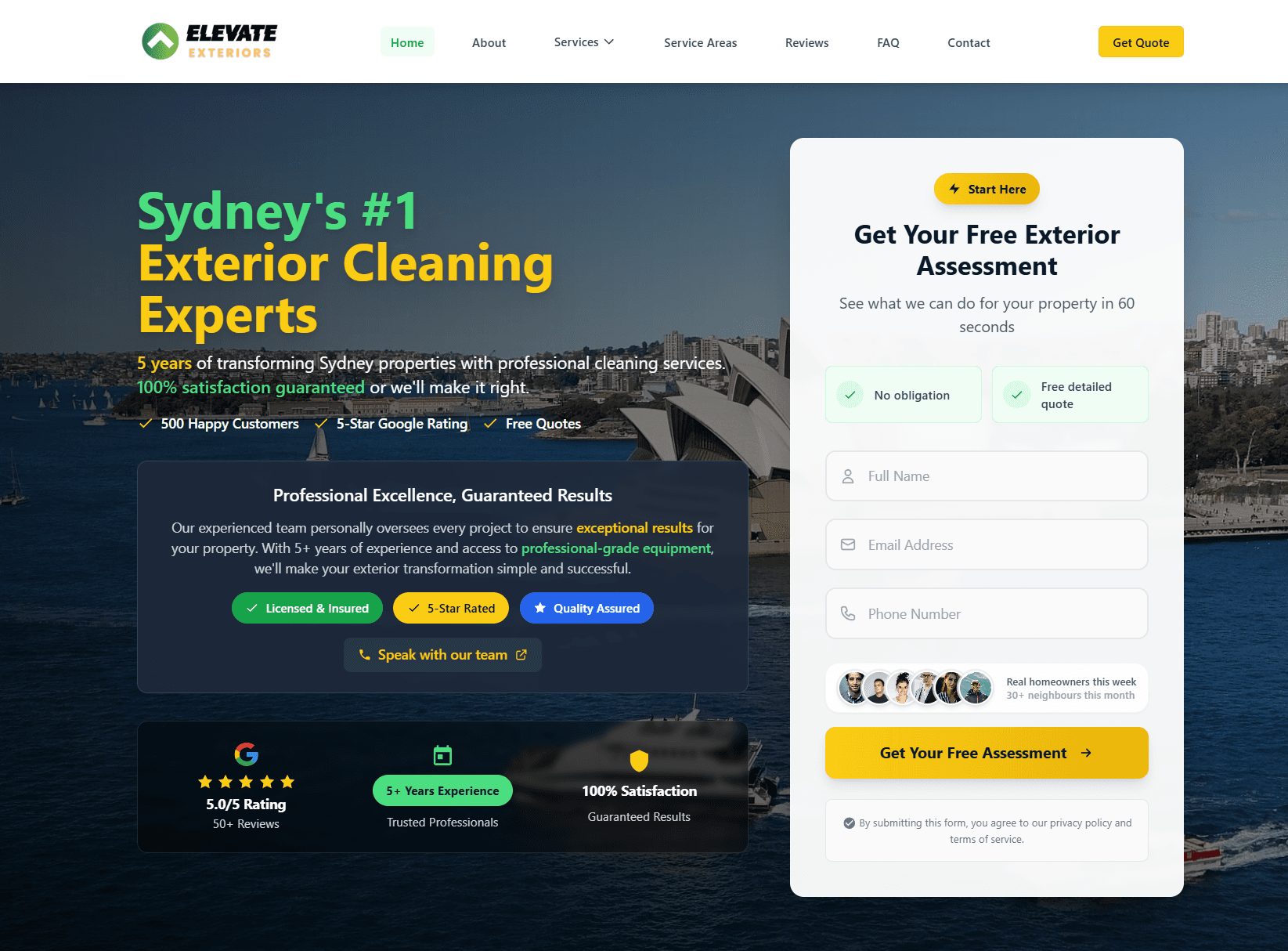
Most Australian service businesses doing this math find that paid leads cost 2 to 5 times more per closed customer than organic, but the organic number only becomes available after 6 to 12 months of investment. That is the trade-off in one sentence. Pay now and overpay forever, or invest now and reduce cost over time. Same trade-off we walked through with Elevate Exteriors (visit them at elevate-exteriors.com.au): website rebuild plus SEO foundations took 4 to 6 months to mature, then a current floor of 15 to 20 qualified leads per month from organic and the curve is still climbing.

For most Australian service businesses we work with, the right ramp is our SEO retainer running alongside paid for the first 6 months, then layering our website design service if the current site is leaking conversions. The combination is what produces the compounding effect.
Real client. Real results.
Elevate ExteriorsExterior Services
Website rebuild + SEO foundations. After a 4 to 6 month build phase, now generating 15 to 20 qualified leads per month from organic search. No ad spend, lead quality consistently higher than paid traffic.
Quick answers
Frequently asked questions
Tagged with
Written by
Guru, Founder at Vynlox
Sydney based · 8+ years building websites · 100% client retention
I started Vynlox after watching too many good Australian businesses get burned by agencies that send reports, not results. Every strategy call you book is with me directly. You won't be handed off to a junior. You work with me.


