


Vynlox
Founder, Vynlox
Most businesses in Australia looking to hire an SEO specialist are making the same expensive mistake: they''re choosing based on pitch decks and case study size, not actual capability.
They end up paying $4,000 to $8,000 a month to a mid-tier agency where an account manager books a monthly call, a freelancer (or junior developer) runs the work, and the specialist you spoke to during the sales call never touches the account again.
Six months later, traffic flatlines. Budget''s gone. Nobody can explain why.
Free SEO audit · No obligation
Curious how your site ranks today?
We'll audit your current SEO, identify the biggest opportunities, and send the report. Free, no obligation.
Get a Free SEO AuditThe problem is that "SEO specialist" means almost nothing in Australia right now. Some people use it to mean "content writer who vaguely knows Google." Others use it for general marketing contractors who''ve read three blog posts about keywords. A few actually know what they''re doing.
Here''s how to tell the difference.
What a real SEO specialist actually does (vs the content-mill version)
Most agencies in Australia sell content. Lots of it. They pitch "content strategy" as the answer to everything, deliver blog posts on a schedule, and call it SEO.
Real SEO is different. It starts with diagnosis, not assumptions. A real specialist will:
Run a technical audit first. Before writing a single word, they audit your site for crawlability, Core Web Vitals, schema, robots.txt rules, redirect chains, and internal linking structure. They''ll find the broken things nobody else is looking at. Content mills skip this entirely, they''ve never even heard of Core Web Vitals.
Map your actual traffic gaps. They analyse which keywords you''re already ranking for (but not driving clicks on), which ones you''re missing entirely, which pages are leaking traffic to competitors. They use Search Console and GSC data, not just general keyword research tools. Content mills don''t have Search Console access, they just pitch "top 100 keywords in your niche."
Build internal-link strategy. Real SEO specialists understand that internal links tell Google which pages matter most on your site. They''ll restructure how your pages connect to each other so authority flows to revenue-generating pages, not blog archives. This takes analysis and planning. Content mills throw blog posts at a site and leave it as orphaned as ever.
Test and iterate. They track what actually moves the needle, leads, calls, revenue, not just "rankings" or "organic traffic" in a vacuum. They adjust when data shows something isn''t working. Content mills publish on a calendar and never look back.
Actually know your business. A good specialist spends time understanding your value prop, your sales cycle, your competitors'' strengths. They don''t sell you generic strategies. Content mills pitch the same playbook to every client in the same industry.
The difference is between someone solving a problem and someone selling hours.

Red flags to spot a fake SEO specialist in Australia
If you''re researching firms locally, watch for these:
They pitch you on "content marketing" before they''ve audited your site. A real specialist asks questions before proposing solutions. If someone''s pitch deck is 80% blog post samples and 20% "we''ll also do SEO," they''re a content agency pretending to be an SEO shop.
They won''t give you access to Search Console or GA4. Some Australian agencies "manage your analytics" by logging in themselves and sending you monthly PDFs. Real specialists hand you direct access so you can verify the data yourself. If they won''t, they''re hiding something.
They can''t explain their exact process in plain language. Ask them: "Walk me through what you''ll do in month one." If the answer is vague ("we''ll optimise your content and build backlinks"), they''re selling fog. A specialist should describe a specific sequence: audit → on-page fixes → internal structure → content map → etc.
They guarantee rankings. Google updates its algorithm 500+ times a year. Any agency guaranteeing "rank #1 for X keyword by month 3" is lying. Real specialists guarantee process and transparency, not outcomes they don''t control.
They''re obsessed with domain authority or linking domains. These are vanity metrics. Low-authority sites beat high-authority ones every day because intent and relevance matter more. If a specialist is selling you a backlink-building service as the core strategy, they''re probably a 2010s SEO firm stuck in time.
They don''t mention your business goals at all. A good specialist ties SEO to your actual metrics: leads, qualified calls, customer acquisition cost. If they''re only talking about traffic and rankings, they don''t understand why you''re hiring them.
What good SEO reporting looks like
Before you hire, ask for a sample monthly report. Here''s what a real one should include:
Search Console data. Actual keywords you''re ranking for, impressions, clicks, average position. Not guesses or tool-based estimates. Show me real Google data.
Traffic by source and page. Organic traffic to your site, but also broken down: which pages are earning the traffic, which are new, which are declining. A dashboard that only shows "total organic traffic up 15%" tells you nothing. You need the page-level breakdown.
Lead or conversion data. Traffic is nice. But did any of that traffic actually call you or fill a form? A specialist tracks this. Most agencies don''t have visibility into conversions, so they can''t tie SEO to actual revenue.
What changed this month. Specific on-page optimisations, new pages published, technical fixes, internal link restructures. Not "content was created" but "5 product pages were optimised for local search intent and interlinked to the service hub."
What''s planned next month. SEO is not linear. A real specialist will explain what they''re testing next and why. Content mills just churn out more blog posts.
Pricing benchmarks for Australian SEO specialists
Real retainers in Australia sit in these ranges:
| Service Level | Monthly cost | Best for | What it includes |
|---|---|---|---|
| Freelancer or small team | $1,500 to $2,500 | Businesses ready to grow; tight budgets | Audit, strategy, on-page work, technical fixes |
| Mid-tier specialist firm | $2,500 to $4,500 | Growing businesses wanting hands-on strategy | Everything above plus content planning, competitor tracking |
| Full-service growth agency | $4,500 to $8,000+ | Larger brands or multi-channel campaigns | SEO plus paid, conversion, content, ongoing optimisation |
The catch: price doesn''t equal quality. A $5,000 agency with five people on your account is not necessarily better than a $3,000 specialist doing the work themselves.
What matters is: (1) is the person you hire during the sales call actually the person doing the work, (2) do they have process and can explain it, (3) can they show results for similar businesses, (4) do they tie metrics back to your revenue.
When to hire vs build in-house vs DIY
Hire a specialist if:
Your business needs consistent organic traffic but you don''t have an in-house marketer yet. A good retainer is cheaper than a full-time hire and you avoid the risk of hiring the wrong person. For example, RyRo Loan Centre (visit them at ryroloancentre.com.au) generated 22 leads in 90 days from organic search with zero ad spend, that return doesn''t happen without a real specialist and a real process.
You''re in a competitive niche (legal, accounting, trades, SaaS) where organic rankings actually drive revenue. If your customers start with Google, you need someone who understands the nuances of your niche. Generic agencies won''t cut it.
You''ve tried DIY or freelancers and hit a ceiling. You''ve got the foundations but rankings won''t budge. A diagnostic from a specialist often reveals the blocker, usually technical, or internal linking structure, or misaligned content targeting.
Build in-house if:
You''re already hiring a digital marketer or operations person. Add SEO to their toolkit. But train them properly, one online course doesn''t make someone an SEO specialist.
You have the budget and the patience to wait 6 to 12 months while someone learns. In-house moves slower because your person is learning while working.
You want direct control and you''re willing to invest time in staying current with algorithm changes.
DIY only if:
Your business is very small (under $500k revenue) and growth is not urgent. You can move slowly and learn as you go.
You''ve got technical skills or someone on your team who does. SEO without technical foundation is just guessing. You need someone who can read code, understand server logs, and talk to developers.
You''re willing to spend 10 to 15 hours a week on it. If you''re trying to DIY SEO in 2 hours a month, you''re wasting your time.

How to interview an SEO specialist (5 questions that matter)
1. "Can you walk me through your exact process in month one?"
Listen for: specific steps (audit → analysis → prioritised fixes), not vague promises. A specialist should describe their system.
2. "How will you measure success, and how often will you report it?"
Listen for: mention of your business goals (leads, calls, revenue), not just rankings. Monthly reporting minimum.
3. "What was your biggest SEO failure, and what did you learn?"
Listen for: humility and a real story, not a deflection. SEO is iterative. Anyone claiming 100% win rate is selling a story.
4. "Show me three recent client results."
Listen for: before/after traffic/lead metrics, not just rankings. Ask to speak to one of those clients if possible.
5. "If I hire you and rankings don''t move in month two, what''s your hypothesis?"
Listen for: they explain that SEO is not linear, they have a plan to diagnose why, they''re not panicking. If they promise month-two results, walk away.
The answers will tell you if you''re talking to a specialist or a content mill.
A real SEO specialist also helps you decide IF SEO is the right channel for your business. We covered the honest math in our SEO worth-it analysis and the playbook for one specific vertical in our SEO guide for plumbers.

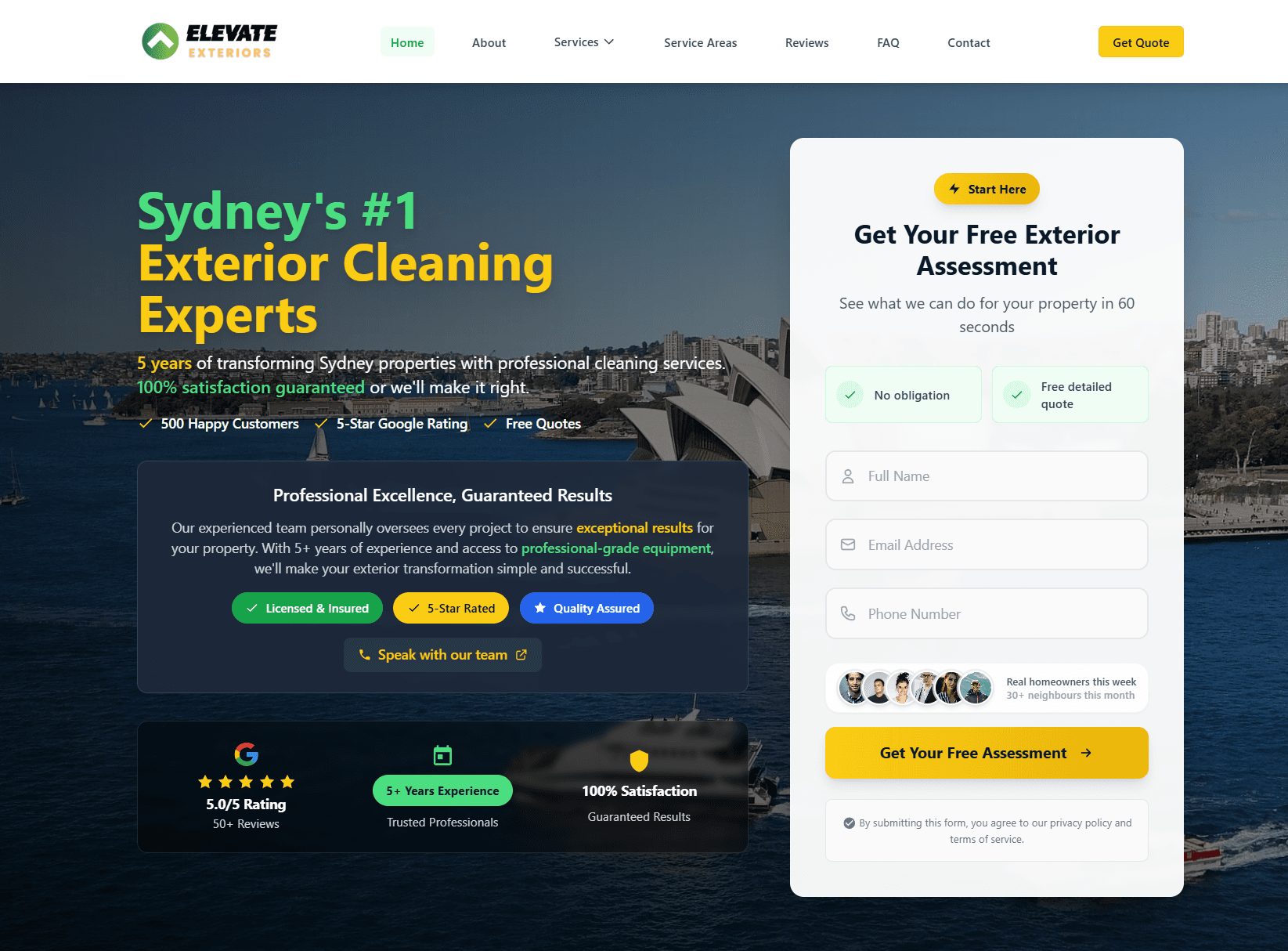
Real client. Real results.
Elevate ExteriorsExterior Services
Website rebuild + SEO foundations. After a 4 to 6 month build phase, now generating 15 to 20 qualified leads per month from organic search. No ad spend, lead quality consistently higher than paid traffic.
Quick answers
Frequently asked questions
Tagged with
Written by
Guru, Founder at Vynlox
Sydney based · 8+ years building websites · 100% client retention
I started Vynlox after watching too many good Australian businesses get burned by agencies that send reports, not results. Every strategy call you book is with me directly. You won't be handed off to a junior. You work with me.


