


Guru
Founder, Vynlox
Most accountants in Australia spend $2,000 to $10,000 per month on Google Ads and LinkedIn while their organic search presence sits broken in the background. Their phone doesn't ring from search. Their best prospects haven't been found by Google in months. New enquiries arrive through paid clicks that stop the moment the budget runs out. That's a problem. It's also an opportunity. Search-driven growth done right gives accountants a compounding asset. No more ad-spend treadmill. If you want this done for you, request a free proposal.
Why accountants need a different digital marketing approach
Accountants aren't selling a commodity product. A prospect looking for a tax accountant isn't comparing your hourly rate against five others on a spreadsheet. They're looking for someone they can trust with their business financial life. That trust is built on two things: expertise and availability. You can't be available to 10,000 prospects at once, so you need to be visible to the ones who are actively searching.
Free SEO audit · No obligation
Curious how your site ranks today?
We'll audit your current SEO, identify the biggest opportunities, and send the report. Free, no obligation.
Get a Free SEO AuditMost digital marketing advice is built for B2C businesses or software startups. You'll hear about viral content, social media engagement, and brand awareness. None of that works for accounting. Your prospects don't engage with your LinkedIn post about tax depreciation. They Google "accountant near me" or "small business tax help" when they need you, and if you're not there, they call someone else.
The digital marketing that works for accountants is the marketing that puts you in front of the people who are already searching. That's search, answer engines, and maybe Google Business Profile. It's not always about volume. It's about conversion. One enquiry from Google worth $5,000 in annual fees beats 100 LinkedIn impressions worth zero.

The digital marketing playbook for accountants
This isn't a "do everything" strategy. It's a priority stack based on what actually converts prospects into clients.
1. Organic search (SEO) is your foundation
Google is where your prospects start. "Small business accountant Sydney", "tax deductions for contractors", "SMSF audit requirements" - these searches happen every day from people who need you. If your website doesn't rank for them, you're invisible.
SEO for accountants is different from SEO for most businesses. You're not competing on brand. You're competing on trust signals and expertise. That means your website needs to prove you understand the tax code, the compliance calendar, and the specific pain points of your niche (contractors, small business owners, SMSF trustees, whatever you target).
Our SEO retainer for accountants focuses on the search terms that convert. We avoid vanity metrics and focus on the searches that bring people who can become paying clients. As we've seen with Switch Accounting (visit them at switchaccounting.com.au), even a site rebuild focused on search foundation can shift the dial from zero online visibility to a consistent pipeline.
A solid organic search program takes 4 to 6 months to compound. That's the trade-off. But once it works, it keeps working. Unlike paid ads, you don't pay per click. The traffic is yours to keep.
2. Answer engines (AEO) are the new frontier
ChatGPT, Perplexity, Claude, Google's AI Overviews - these are where prospects go first now. They ask a question in plain English and get an answer citing sources. If your website isn't one of those sources, you're losing visibility.
AEO (Answer Engine Optimisation) is different from SEO. It's about being the authoritative source that AI systems cite. It's newer than traditional search, which means fewer accountants are doing it. That's your advantage. Answer Engine Optimisation done right puts your firm in front of prospects who are asking AI about tax, accounting, and compliance before they ever hit Google.
The timeline is faster than SEO. You can see traction in 4 to 8 weeks. The effort is less. You're not building rankings across 50 keywords. You're establishing authority on the questions your prospects are actually asking.
3. Google Business Profile keeps local search honest
If you serve a specific city or suburb, GMB is non-negotiable. Your profile needs your address, phone, hours, and regular posts. When someone searches "accountant 2000" or "bookkeeper Parramatta", Google shows a map with three local results. You need to be in that map.
Most accountants set up their GMB profile once and ignore it for three years. Posts sit stale. Reviews pile up unanswered. The profile looks abandoned. If you're going to be on Google Maps, maintain it. Answer reviews weekly. Post your office hours around tax time. Add a link to your free tax checklist or SMSF guide.
This takes two hours a month. It's not glamorous. It also converts. Local search is where price-sensitive, ready-to-hire prospects live.
4. Referral + word-of-mouth can't be automated (and shouldn't be)
The best prospects still come from a warm introduction. Your client refers their friend. The friend calls you, pre-sold. That doesn't scale in the same way as search, but it compounds. Each good client you serve refers another.
The way to boost referrals isn't to build a referral program with complicated point systems. It's to make your clients happy enough that they volunteer your name to their business owner friends. That means delivering on your promises, responding fast, and explaining complicated tax stuff in plain language.
See how we've helped other accounting firms grow through a mix of these channels.
SEO vs paid ads vs AEO for accountants
The three channels compete for your marketing budget. Here's how they stack up.
| Channel | Time to results | Cost | Effort | Best for |
|---|---|---|---|---|
| SEO (organic search) | 4 to 6 months | $1,500 to $4,000/month | High upfront, low ongoing | Accountants ready to build a long-term asset |
| Paid ads (Google, LinkedIn) | Immediate | $2,000 to $10,000/month depending on clicks | Medium | Testing a niche quickly or seasonal boosts |
| AEO (answer engines) | 4 to 8 weeks | $800 to $2,500/month | Medium | Being visible in ChatGPT and Perplexity from day one |
| GMB + local | Immediate | $0 to $500/month | Low | Accountants in a specific city or suburb |
The firms we work with usually combine two or three of these in parallel. RyRo Loan Centre (visit them at ryroloancentre.com.au) ran Google Ads while we built their organic presence. After three months, organic was outperforming paid on every metric, and they could cut ad spend. That's the progression we see most often.
If you're new to digital marketing for accounting, start with SEO and GMB (the compounding assets) while you test paid ads for short-term volume. Once organic is working, you can scale back paid and reinvest the savings into AEO.

How to measure success and build the business case
Your marketing spend should be measurable. You need to track: how many enquiries come from search, how many turn into clients, and what the lifetime value of each client is. That's how you know if your marketing is working.
Most accountants I talk to don't track this. They spend $5,000 on ads or SEO and have no idea whether it brought in business. That's why it feels risky. It's not risky if you measure it.
Set up Google Analytics 4 on your website. Track form submissions by source (organic, paid, direct, referral). When you get an enquiry, ask them where they found you. After a few months, you'll have a clear picture of which channel is bringing the best-quality prospects.
Here's the maths. If your average client lifetime value is $10,000, and you need three clients a year to justify your marketing spend, then you're looking for $30,000 in annual revenue per client you acquire. That means you can spend up to $10,000 per year on marketing to acquire one client and still break even. Most accountants find they acquire one solid client every two to three months from a combined SEO and GMB approach, which is far better than the breakeven.

For a related local-service-business playbook, see our SEO guide for plumbers. The economics carry across verticals.
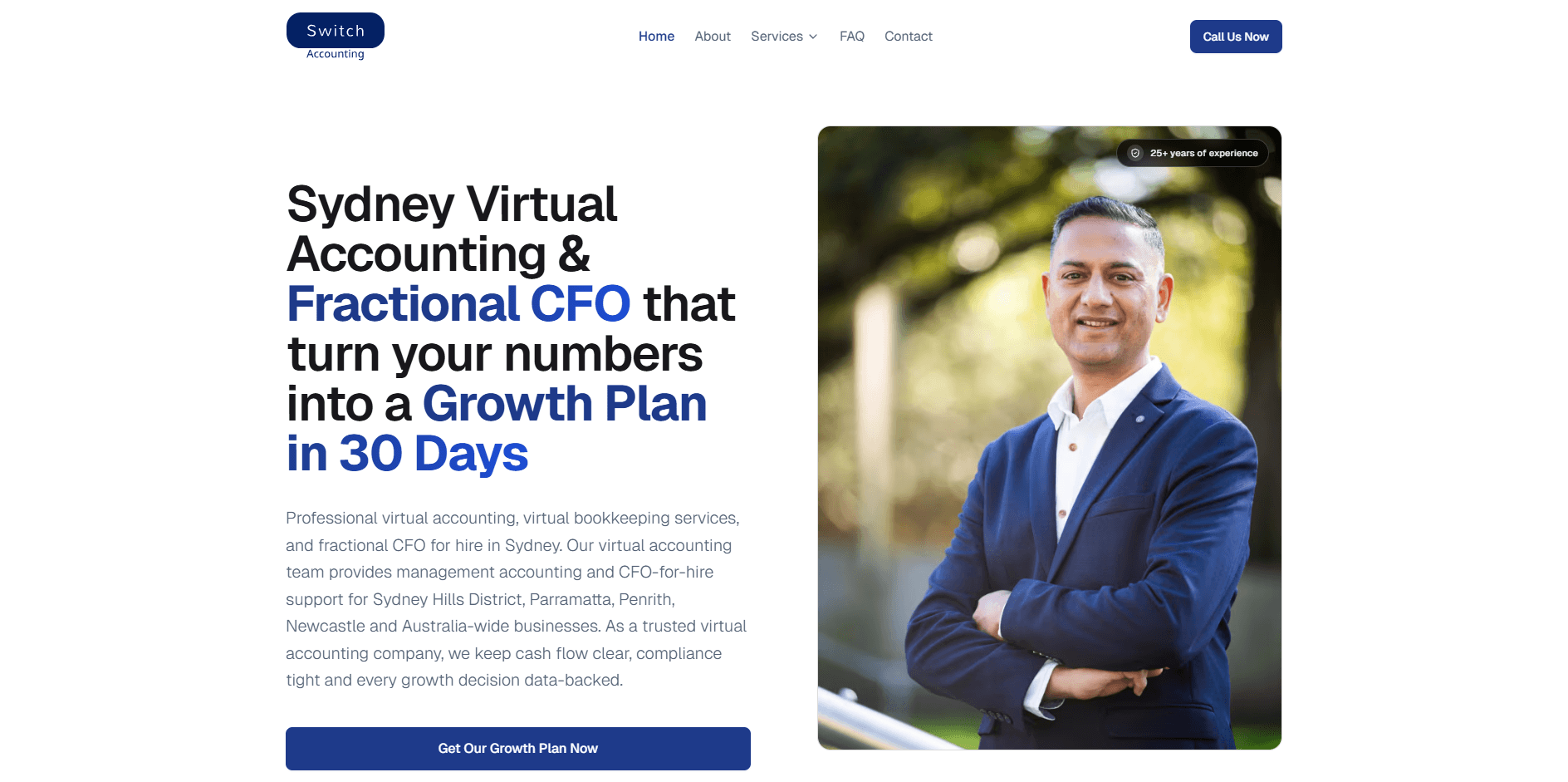
Real client. Real results.
Switch AccountingAccounting
Transformed a basic business-card site into a professional, modern website that builds trust with anyone who finds the business.
Quick answers
Frequently asked questions
Tagged with
Written by
Guru, Founder at Vynlox
Sydney based · 8+ years building websites · 100% client retention
I started Vynlox after watching too many good Australian businesses get burned by agencies that send reports, not results. Every strategy call you book is with me directly. You won't be handed off to a junior. You work with me.


