

Vynlox
Founder, Vynlox
A website in Australia in 2026 costs anywhere from $300 to $50,000+ depending on what you actually need. Here''s the breakdown most articles skip.
If you''ve been bouncing between quotes, confused by why one developer charges $2,000 and another $20,000, you''re not alone. Website pricing in Australia is chaotic. Some agencies bundle everything into a flat fee; others break it into build, hosting, maintenance, and ongoing optimisation. A few charge a retainer. Most don''t explain what they''re actually charging for.
The real question isn''t "how much does a website cost?" It''s "what does your website need to do, and what are you willing to invest in making it work?"
Free quote · No obligation
Want a website that actually converts?
We'll review your current site (or sketch out a new one) on a free 30 minute strategy call.
Book a Free Strategy CallLet''s break down the actual numbers.
The Cost Tiers: What You''re Actually Paying For
The price you pay depends on four things: complexity, customisation, hosting and maintenance, and whether you''re treating your site as a one-time expense or a revenue-generating asset.
| Website Type | Build Cost | Hosting/Year | Maintenance/Month | Best For |
|---|---|---|---|---|
| DIY (Wix, Squarespace) | $0-300 | $60-240 | $0 | Solo trades, personal brands, experiments |
| Template builder (WordPress template) | $300-1,500 | $120-300 | $50-200 | Small teams with basic needs |
| Small professional build | $1,500-5,000 | $120-300 | $150-400 | Local services, tradies, small offices |
| Pro custom design | $5,000-15,000 | $240-600 | $200-500 | Growing businesses, ecommerce, lead gen |
| Enterprise custom | $15,000-50,000+ | $500-2,000 | $500-2,000+ | Complex systems, high traffic, custom integrations |
This table is deceptive though, because it only shows the build. A website isn''t "done" when you launch. What matters is the total cost of ownership over the first two years.

Tier 1: DIY Website Builders ($0-300 upfront)
Wix, Squarespace, GoDaddy, Weebly. You pick a template, drag in your photos and text, and publish. Some charge nothing if you use their subdomain ($0-300 with your own domain). Hosting is included.
Total year-one cost: $60-300.
Pros: Fast. No code. You own the content.
Cons: Slowdowns at scale. Limited customisation. SEO ceiling (hard to rank for competitive terms). Vendor lock-in; moving your site later costs thousands. No one''s building these as professional assets in 2026.
When to use it: Testing an idea. Solo coach or freelancer with a one-page bio site. Short-term experiments.
What we see: Solo landscape designers in Sydney use Wix. They get 2 to 4 leads a month, mostly from friends. The site looks fine. It pays for itself. Then they hit a glass ceiling. Google doesn''t rank them for "landscape design Sydney" because the site can''t compete on speed, structure, or content depth. They end up spending $3,000 on Google Ads just to get the leads a proper website would bring organically. We usually suggest a rebrand at that point.
Tier 2: Template-Based Website ($300-1,500 build)
A developer buys a WordPress theme, customises the copy and colours, plugs in your logo, adds a few photos, and publishes. Hosting is separate (typically $10-50/month via GoDaddy, Bluehost, or Kinsta). Your own domain ($10-50/year).
Total year-one cost: $300-2,000 (build + hosting + domain + possibly some maintenance).
Pros: Faster than custom. Cheaper upfront. Still looks professional. Basic SEO optimisation.
Cons: Thousands of other sites use the same template. No competitive edge. Limited to template features. Hard to scale into ecommerce or membership features later. Maintenance can sneak up on you (plugin updates, security patches).
When to use it: Local service business with a tight budget. Dentist, accountant, plumber who needs a credible online presence but doesn''t expect the site to generate 80% of their leads.
What we see: We rebuild dozens of these every year. A plumbing contractor in Strathfield paid $1,200 for a template build in 2023. Two years later, it''s slow, outdated, barely gets 30 visits a month from search, and costs $150/month in ads to hit quota. A proper build would''ve cost $4,000 but would generate 15 to 20 organic leads monthly. The economics flip after month six.
Tier 3: Small Professional Build ($1,500-5,000)
A small agency or freelancer builds a custom-coded site. Usually 5 to 7 pages, mobile-responsive, basic SEO, some custom styling. Hosting is managed by the builder (typically $20-50/month, passed through or included). You get updates, security patches, and basic ongoing support.
Total year-one cost: $2,000-6,500 (build + hosting + domain + first-year support).
Pros: Faster load times than templates. Can be fully custom without the enterprise price. Actual support when things break. SEO-friendly structure from the start.
Cons: Still limited scalability. If you later want ecommerce, membership, or complex integrations, you''re rebuilding. Dependency on your builder for changes.
When to use it: Growing local service business. Professional firm (lawyer, accountant, dentist) that needs lead generation. Tradie wanting a proper online presence.

Tier 4: Professional Custom Design ($5,000-15,000)
A design-led agency builds a bespoke site. You get brand strategy, UX research, custom interactions, illustration or animation, performance optimisation, and integrated CMS. This is what Vynlox builds. Build takes 8 to 16 weeks.
Total year-one cost: $6,500-20,000 (build + hosting + domain + maintenance + possibly SEO retainer start).
Pros: Converts like crazy. Fast. Ranks well in search (when paired with SEO work). Scalable architecture. You own it forever. Support is included; designers actually know what they''re doing.
Cons: Takes longer. Requires clear thinking about your audience and goals upfront.
When to use it: You''re serious about growth. You''ve done the research; you know what revenue per lead looks like. You want a site that compounds in value over time.
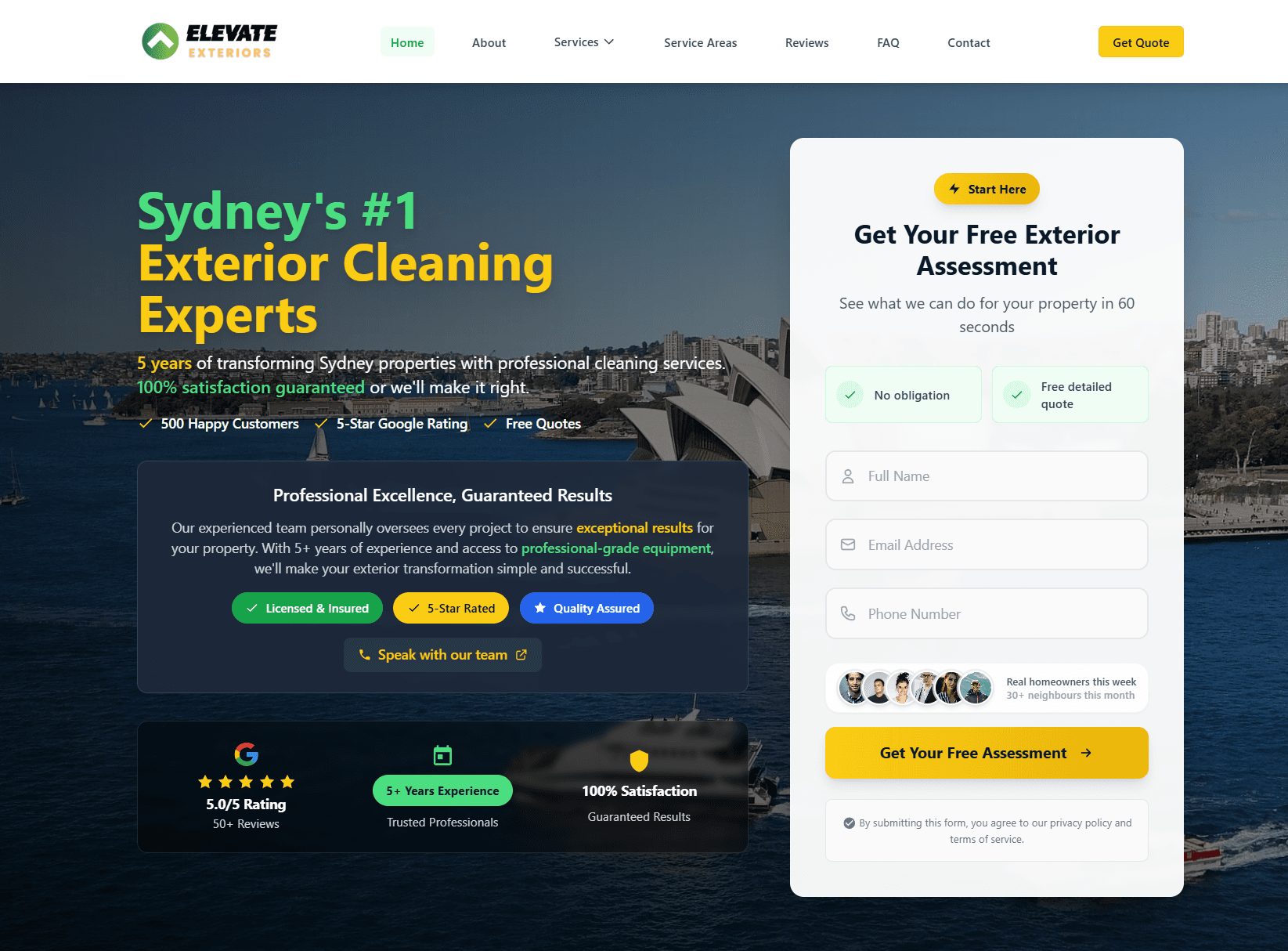
Real example: Elevate Exteriors (visit them at elevate-exteriors.com.au) went from a template site pulling 2 leads a month to a custom design pulling 15 to 20 organic leads monthly within six months, and continuing to climb every quarter. Initial build was $8,000. Hosting and maintenance run $300/month. First-year total: $11,600. They''ve since done SEO retainer work and are at 25+ leads monthly from organic alone. ROI hit positive in month four.
Tier 5: Enterprise Custom Build ($15,000-50,000+)
Full-stack custom development. Bespoke CMS, user accounts, custom integrations (Salesforce, accounting software, booking systems), complex ecommerce, API connections. Typically 16+ weeks build time. Ongoing development retainer ($2,000-5,000/month).
Total year-one cost: $25,000-70,000+.
When to use it: You''re a mid-to-large company with complex needs. Ecommerce with thousands of products. Marketplace. Software-as-a-service (SaaS). Integration with your backend systems is non-negotiable.
The Hidden Costs Nobody Mentions
Build price is only the opening act. Here''s what actually determines total cost of ownership.
Hosting ($5-100/month)
Cheap shared hosting ($5-15/month) is slow and insecure. You''ll churn users on mobile. Managed WordPress hosting (Kinsta, WP Engine) runs $35-100/month but includes backups, security, and support. Vynlox sites run on Vercel or managed Supabase ($0-200/month depending on traffic). Most clients pay $30-50/month.
Domain ($10-50/year)
Straightforward. Use Vercel, Namecheap, or GoDaddy. Premium domains (one-word .com.au) cost more. Standard .com.au is $10-15 a year.
SSL Certificate ($0-100/year)
If you use managed hosting or Vercel, it''s free. If you''re on basic hosting, $50-100/year. Non-negotiable; Google ranks HTTPS-only sites higher.
Maintenance & Updates ($50-500/month)
WordPress sites need plugin updates, security patches, backups. This is where template sites blow up. Unmaintained WordPress sites get hacked. Fixing a breach costs $2,000 to $10,000.
Custom-built sites (like Vynlox builds) include maintenance in the hosting. Updates are batched quarterly. Security is built in from day one.
Content Creation ($500-3,000/month)
A website needs fresh content to rank in Google. Blog posts, case studies, video, photography. Budget $500-2,000/month if you''re serious about organic growth.
SEO (ongoing) ($500-2,500/month)
The site is built. Now rank it. On-page optimisation, technical SEO, content strategy, backlink building. This is separate from the build and it''s where most growth happens.
Paid Ads ($0-5,000+/month, optional)
Google Ads, Facebook/Instagram, LinkedIn. Optional if you''re winning organically. Mandatory if you need leads in month one. Budget $500-2,000/month to test, $2,000-5,000+/month to scale.
Real Cost of Ownership: Build + 24 Months
Here''s what your site actually costs over two years.
DIY Tier:
- Build: $300 | Hosting: $240 | Maintenance: $0 | SEO: $0 | Ads: $2,400 (to backfill organic) | Total: $2,940
- Outcome: 4 to 8 leads per month (mostly paid)
Template Tier:
- Build: $1,500 | Hosting: $480 | Maintenance: $1,200 | SEO: $0 | Ads: $2,400 | Total: $5,580
- Outcome: 8 to 12 leads per month (paid + organic)
Small Professional:
- Build: $3,500 | Hosting: $600 | Maintenance: $2,400 | SEO: $6,000 | Ads: $0 | Total: $12,500
- Outcome: 15 to 20 leads per month (organic)
Professional Custom (Vynlox standard):
- Build: $8,000 | Hosting: $600 | Maintenance: $2,400 | SEO: $18,000 | Ads: $0 | Total: $29,000
- Outcome: 25 to 40 leads per month (organic, compounding monthly)
Enterprise:
- Build: $30,000 | Hosting: $3,600 | Maintenance: $24,000 | Integrations: $12,000 | SEO: $18,000 | Total: $87,600
- Outcome: Custom; depends on product market fit
The gap widens after month 12 because the professional build + SEO compounds: more search visibility, lower cost per lead, repeat business from happy customers. The DIY site stays flat. The paid ads bucket grows.
How to Pick the Right Tier for Your Business
Ask yourself three questions:
1. What''s your revenue per customer?
- If it''s under $500, a $1,500 template build is probably fine.
- If it''s $2,000 to $10,000, a professional build ($5,000-10,000) ROIs within six months.
- If it''s $10,000+, invest in a proper build and SEO. The payback is three months.
2. How much of your revenue comes from web leads vs. referral?
- If 80% is referral and 20% is web, DIY is fine. Focus on referral.
- If 50% is web, you need a professional build and SEO. That''s your growth engine.
- If you want 80% web leads, you need Tier 3 or 4 plus paid ads or SEO.
3. Can you commit to content and SEO for 6 months?
- If no, paid ads cover the gap but they''re expensive.
- If yes, SEO retainer work pays for itself within four to six months.

Why Vynlox Sites Are Worth the Investment
We typically build in Tier 4: $8,000 to $15,000 for custom design, fast performance, SEO-ready structure, and scalability. Here''s what you get.
Performance: Most Vynlox sites load in under 1.5 seconds on 4G. Template sites load in 3 to 5 seconds. Google ranks speed. Conversion rates correlate with speed. Clients see a 15 to 30% lift in conversion from speed alone.
Lead generation: A Tier 4 site + SEO retainer compounds. Month one you''re at 3 to 5 organic leads. Month six you''re at 15 to 20. Month twelve you''re at 25 to 40 and the cost per lead has dropped by 60%.
Ownership: You own the code, the content, the design. No vendor lock-in. If we part ways, you walk with a fully functional site. Template sites? You''re stuck with their ecosystem.
Support: If something breaks, we fix it within 24 hours. We handle updates, security, performance monitoring. You focus on sales.
Real example: Switch Accounting (visit them at switchaccounting.com.au) had a basic online presence, just an about page and contact form. No organic traffic. After a Vynlox build and six months of SEO work, they''re getting 8 to 12 inbound leads per month from Google. The site is now their primary lead source instead of networking alone.
Cost is one part of the picture; what the site actually produces is the other. We walked through the SEO economics that turn a website into a compounding asset in our complete dental SEO guide and our SEO playbook for plumbers. The same logic applies regardless of build cost.
The Bottom Line
A website in Australia in 2026 costs $300 if you don''t care about leads, or $5,000 to $15,000 if you do. The real cost is build plus two years of hosting, maintenance, and SEO. That math flips at month six when organic leads compound.
If you''re still bouncing between quotes, ask yourself: "What am I investing this for?" If it''s a brochure, go cheap. If it''s a revenue machine, invest in a professional build and pair it with SEO work. The ROI is three to four months, not three to four years.
If you want to see what a Tier 4 build looks like and how it performs in search, get a free proposal. We''ll walk you through the costs and the timeline.
Real client. Real results.
Elevate ExteriorsExterior Services
Website rebuild + SEO foundations. After a 4 to 6 month build phase, now generating 15 to 20 qualified leads per month from organic search. No ad spend, lead quality consistently higher than paid traffic.
Quick answers
Frequently asked questions
Tagged with
Written by
Guru, Founder at Vynlox
Sydney based · 8+ years building websites · 100% client retention
I started Vynlox after watching too many good Australian businesses get burned by agencies that send reports, not results. Every strategy call you book is with me directly. You won't be handed off to a junior. You work with me.


