

Guru
Founder, Vynlox
Most Australian small business owners spend tens of thousands of dollars on Google Ads while their website leaks every visitor that lands on it. They have a Wix template from 2021. Their hero says "Welcome to our website". Their phone number is buried in the footer. Every paid click is sent to a leaky bucket, and the moment the ad budget stops, the leads stop.
That is a problem. It is also an opportunity. A properly-designed small business website is the foundation that everything else (SEO, AEO, paid ads, referrals) compounds on top of. Get the website right and every dollar you spend on traffic produces more. If you want this assessed for your business, request a free proposal and we will send a tailored plan within one business day.
What "good" looks like for a small business website in 2026
Free quote · No obligation
Want a website that actually converts?
We'll review your current site (or sketch out a new one) on a free 30 minute strategy call.
Book a Free Strategy CallThree things separate a small business website that works from one that does not. First, a clear single-purpose hero that tells the visitor what you do and how to act in the first 3 seconds. Second, conversion fundamentals (trust signals, social proof, friction-free forms) that turn visitors into enquiries. Third, technical foundations (speed, mobile, schema) that let SEO and AEO compound on top.
Most small business sites fail on all three. Hero says "Welcome to
The 6 conversion fundamentals every small business site needs
Skip any one and the site under-converts. Get all six and you compound.
1. Above-the-fold clarity
Your hero must answer three questions in the first 3 seconds: what do you do, who is it for, what should I do next. "Sydney plumbers, same-day emergency service, call now or book online" beats "Welcome to our website" every single time. Pair it with a single primary CTA (one button, one offer). Avoid the carousel: visitors hate them and they kill conversion.
2. Trust signals in the right order
Google reviews, real client logos, case study links, professional certifications. Place them where the visitor naturally looks for them: just below the hero, again before the form, and on every service page. Real reviews from named clients beat anonymous testimonials. Real photos of your team beat stock images.
3. A friction-free form
Three fields maximum: name, email, message. Make phone optional. Avoid captchas (they kill conversion); use a hidden honeypot field instead. Confirm submission with a clear thank-you screen. Never silently drop a submission.
4. Service pages that match search intent
Every service line you offer should have its own page. For local service businesses, every suburb you cover should have its own page. The math: 8 services x 10 suburbs = 80 unique landing pages, each targeting one suburb-service combination. You do not have to build all 80 on day one. Start with the top 12. We covered the local-SEO mechanics in detail in our SEO playbook for plumbers.
5. Mobile-first design and speed
Over 70 percent of Australian local searches happen on mobile in 2026. If your site loads in 5 seconds on 4G, half your visitors leave before the hero renders. Target sub-2-second mobile load. Compress images. Skip animations. Use a modern framework (Next.js, Webflow Pro, Astro) instead of a builder template.
6. Schema and on-page SEO foundations
LocalBusiness, Service, FAQ, BreadcrumbList. These are the structured-data signals that let Google's local algorithm and AI search engines understand what you do. Most builder templates skip these entirely. A custom-built site (or a properly-configured Webflow site) handles them out of the box.
The 4 technical foundations that let SEO compound
A converting website is the asset; SEO is the channel that fills it. The technical foundations matter because they decide how much SEO you get for the same effort.
| Foundation | What it does | Why it matters |
|---|---|---|
| Page speed (under 2s on 4G) | Improves Core Web Vitals score | Direct ranking signal; cuts bounce rate by 30 to 50 percent |
| Mobile-first responsive | Renders correctly on every device | Google indexes the mobile version; bad mobile means bad ranking |
| Schema markup (LocalBusiness, Service, FAQ) | Gives Google structured data | Eligible for rich snippets, AI Overviews, knowledge panels |
| Suburb + service page architecture | Targets long-tail local search | Captures "[service] [suburb]" demand at scale |
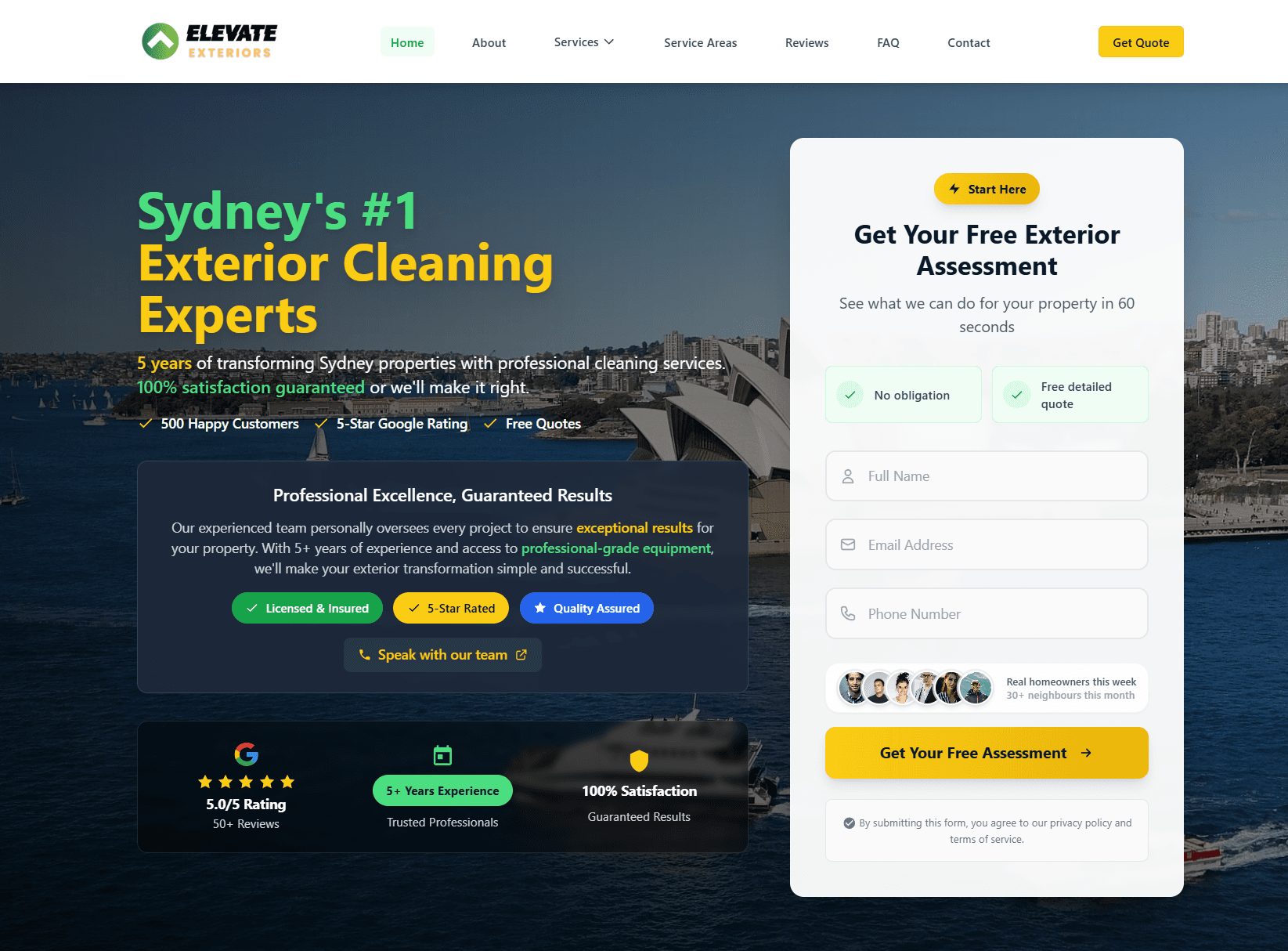
We saw this play out for Elevate Exteriors (visit them at elevate-exteriors.com.au). A full website rebuild plus SEO foundations took 4 to 6 months to mature. Once it did, the site stabilised above a 15 to 20 qualified leads per month floor from organic alone and the curve keeps climbing, no ad spend required.
The same compounding works for RyRo Loan Centre (visit them at ryroloancentre.com.au). 22 qualified leads in 90 days at $0 ad spend, then a steady-state floor of 15 to 20 qualified leads per month from organic plus AI search referrals, and the curve keeps climbing. Different industry, same playbook.

The Australian small business website pricing landscape
What you should expect to pay in 2026 for a real lead-generating website.
| Tier | Price | What you get | Suits |
|---|---|---|---|
| Cheap template | $300 to $1,500 | Builder template, weak SEO | Hobby projects |
| Affordable pro | $2,500 to $7,000 | Custom design, conversion-focused, SEO-ready | Most local service businesses |
| Mid-market custom | $7,000 to $20,000 | Custom front-end + back-end, integrations | Multi-location, growing |
| Enterprise | $20,000 to $100,000+ | Complex e-commerce, large team | National brands, real e-commerce |
Most Australian small businesses sit in the affordable pro tier. That is the price band our typical website design service lands in.
Why website + SEO + AEO is the compounding stack
The website is the foundation. The SEO retainer is the channel that drives organic traffic. AEO surfaces you in AI search engines (ChatGPT, Perplexity, Google AI Overviews) when buyers research their options. Each layer compounds on the others.
Without the website: SEO sends traffic that never converts. AEO mentions you to buyers who land on a leaky site. Ads burn money for nothing.
Without SEO: a great website with no traffic is an art project, not a business asset.
Without AEO: increasingly, you miss the highest-intent buyers who research with AI before contacting anyone. We saw this with RyRo: ChatGPT referrals were consistently the highest-quality enquiries of all three channels.
Get all three working together and you have a defensible asset that compounds for years. Skip one and the system underperforms. We covered the same compounding pattern in our complete dental SEO guide.
How to measure if your website is working
Four metrics, all visible in Google Analytics 4 plus the GBP insights dashboard:
- Conversion rate (form submissions plus phone calls divided by visitors). Target 3 to 7 percent for a service business.
- Bounce rate on landing pages. Anything over 65 percent on commercial pages is a hero or speed problem.
- Mobile vs desktop split (and conversion rate of each). Most small business sites are mobile-first in traffic but desktop-first in conversion. Fix that.
- Cost per lead by source (organic, paid, referral, direct). The compounding website should produce a falling cost per lead over the first 12 months.
If your "web designer" is reporting on anything other than these four metrics, fire them.

Real client. Real results.
Elevate ExteriorsExterior Services
Website rebuild + SEO foundations. After a 4 to 6 month build phase, now generating 15 to 20 qualified leads per month from organic search. No ad spend, lead quality consistently higher than paid traffic.
Quick answers
Frequently asked questions
Tagged with
Written by
Guru, Founder at Vynlox
Sydney based · 8+ years building websites · 100% client retention
I started Vynlox after watching too many good Australian businesses get burned by agencies that send reports, not results. Every strategy call you book is with me directly. You won't be handed off to a junior. You work with me.


