

Vynlox
Founder, Vynlox
Australian businesses are throwing tens of thousands of dollars at "lead-generating websites" that look slick but deliver radio silence. You've probably seen the pitch: "Build a website that attracts clients automatically." Sounds good. Then the invoice arrives: $25k to $80k, and you realise the agency just customised a Webflow template that a competent one-person studio could deliver in three weeks.
Here's the truth nobody tells you: the website itself is not the lead generator. It's an asset. A place where leads land after the real work is done elsewhere, in search engines, on Google Maps, in answer engines like ChatGPT.
Too many agencies sell expensive websites when they should be selling channels. A lead-generating website without a channel strategy is a showroom with no footfall.
Free quote · No obligation
Want a website that actually converts?
We'll review your current site (or sketch out a new one) on a free 30 minute strategy call.
Book a Free Strategy CallWe've built dozens of these for Australian service businesses. Some have pulled past a 15 to 20 qualified leads per month floor from organic search alone and the curve keeps climbing every month. Others hit 22 leads in 90 days without spending a dollar on ads. The difference was never the website price tag. It was the strategy underneath.
This guide breaks down exactly what a real lead-generating website is, the six non-negotiable elements it must have, and how to build one without overpaying.
What actually makes a website generate leads?
A lead-generating website is not magic. It's applied psychology, clear offer design, and channel alignment. Start with this: most websites fail because they try to be everything to everyone. They're beautiful. They're slow. They ask for too much information too early. Visitors leave, and nobody follows up.
A real lead-generator does the opposite. It serves one audience. It makes one offer. It removes friction at every step.
Elevate Exteriors (visit them at elevate-exteriors.com.au) is a case in point. Their old website listed services, told their story, and asked visitors to "get in touch." Over six months, they got three leads from organic. We rebuilt it with a single page that led visitors to one decision: book a free exterior assessment or call directly. Removed all the noise. Within four months they were pulling 15 to 20 leads per month from search and the curve was still climbing. Same business, same market. Different funnel.
The website alone did not create those leads. It was the website plus an SEO retainer that targeted the keywords homeowners actually use ("exterior renovation Sydney", "gutter replacement cost", "roof inspection near me"). The website was the destination. The channel was the delivery.
This is the mental shift every Australian business owner must make: a website is not a lead-gen tool by itself. It's a lead-capture asset that only works when traffic flows to it.
The six elements every lead-generating website must have
1. A crystal-clear offer
Vague value propositions kill conversions. "We'll help you grow" does not trigger action. "We'll add $120k revenue in the next 12 months or we give you the first three months free" does.
Your offer should answer three questions instantly:
- What do you do?
- Who is it for?
- What happens next?
The offer does not live in a headline. It lives in the entire page structure: the form (what you ask for), the copy (what you promise), the call-to-action button (what the visitor clicks to say yes).
2. A friction-free lead form
The longer the form, the fewer submissions you get. This is not opinion. It's math.
For a first-touch lead form on your website, ask for three fields only: name, email, and phone. Everything else can wait until the conversation starts. You do not need their company size, their annual budget, or their childhood fears to send them a proposal.
RyRo Loan Centre (you can visit them at ryroloancentre.com.au) learned this the hard way. Their form asked for six fields, name, email, phone, employment status, income range, and existing loan details. Form abandonment was 67%. We cut it to three fields. Abandonment dropped to 22%. Conversions more than doubled because more people completed it.
Form rule: fewer fields, more responses, better leads.
3. Social proof that actually works
Client testimonials are table stakes. Video testimonials convert better than text. Client logos convert better still because they signal "trusted by real businesses, not just written by the owner."
If you have case studies, show metrics. Not "we grew their business" but "22 qualified leads in 90 days, zero ad spend". Numbers anchor credibility.

4. Trust signals above the fold
Trust signals are the small details that tell the visitor "this person is real and serious." They include:
- Author byline (you, not "the team")
- Photo of your face (real, professional, recent)
- Client logos or case study links
- Credentials or years in business
- A phone number (yes, a real one)
The absence of these signals reads as either hiding or inexperience. Most Australian service websites have neither. They're faceless. Anonymous. That kills conversion.
5. Page speed that does not feel like a test of patience
A page that loads in 2 seconds gets higher conversion than one that loads in 4 seconds. The difference is not subtle. Users abandon slow pages before they even see the offer.
Page speed is also a Google ranking factor. A slow website loses traffic and converts less of what does arrive.
The culprits are usually oversize images (use Unsplash IDs, not full-resolution originals), bloated JavaScript (avoid third-party embed spam), and poor hosting.
6. Mobile-first design
Sixty to seventy percent of your visitors arrive on phones. If your website looks broken or reads like a desktop site squeezed into 375 pixels, you've already lost them.
Mobile-first does not mean "responsive." It means starting the design on a phone, then expanding to desktop. Buttons must be thumb-tappable. Forms must fit the small screen. Copy must be short enough to read without ten scrolls.
| Element | Desktop size | Mobile size |
|---|---|---|
| Hero heading | 48px to 56px | 32px to 40px |
| Body text | 16px to 18px | 16px (no smaller) |
| Button | 12px × 48px min | 44px × 48px min (easier thumb target) |
| Form input | Standard width | Full width on mobile |
The channels that fill a lead-generating website
A website without traffic is a billboard in the desert. The three channels that fill a lead-generating website for Australian service businesses are:
Channel 1: SEO (search engine optimisation)
SEO takes three to six months to show results, but once it does, it compounds. Leads arrive month after month for years without ad spend.
You target keywords your customers actually search: "plumber near me", "dental cleaning cost", "accounting services for tradies". Your website ranks. Traffic flows. Leads convert.
SEO for your industry is not a one-time build. It's a retainer. Keywords, backlinks, and competitor movements shift monthly. A six-month channel build becomes a 12-month advantage. By month 12 you're pulling 20+ leads per month. By month 24 you're the expected choice in your market.
Channel 2: AEO (answer engine optimisation)
ChatGPT, Perplexity, Claude, and Google's AI Overviews are stealing search traffic from traditional Google. If you're not visible in these tools, you're missing leads.
AEO means optimising your content to be the answer these engines cite. Structured data, FAQ sections, clear position statements. It's a three-month play. Results are fast compared to traditional SEO.
Learn more about this in our AEO guide.
Channel 3: Google Business Profile (local search)
If you serve a geographic area, a suburb, a city, a region, Google Business Profile is your channel. It shows up when someone searches your service in your location: "dentist Parramatta", "plumber inner west Sydney".
A complete, optimised GBP with photos, posts, and regular updates pulls leads from Google Maps. It's free. And if you do it properly, it outperforms paid ads for local service businesses.
These three channels work best in parallel. A website plus SEO plus GBP is a system. Add AEO and you're untouchable.

Why agencies charge $50k+ for lead-generating websites
Let's talk money.
A typical agency quotes $25k to $80k for a "lead-generating website." The work? Design, development, SEO basics, and maybe a month of support.
Here's the reality: they're not spending $25k to $80k on labour. They're spending $6k to $12k and pocketing the rest. They've got a Webflow template library. They customise it, swap in your logo, add some copy, and call it bespoke.
The price is not about the quality. It's about the market. Most Australian business owners do not know what a website costs, so agencies charge what they think the market will bear.
A one-person developer charges $5k to $12k for the same work because they do not have agency overhead. A freelancer in India charges $1k to $3k and, for certain projects, delivers the same result.
This does not make expensive agencies bad. Some do excellent, high-touch work and deserve the price. But most? Most are selling a markup on a template.
Our approach is transparent: we charge a fair rate for design and development. Then we sell you the SEO retainer that actually fills the website with leads. The website cost is usually $8k to $15k. The channel (SEO + AEO + GBP optimisation) is $1,500 to $4,000 per month depending on your market.
By month six you've spent maybe $28k total and you're pulling 15 to 20 leads a month, with the curve still climbing every quarter as the asset matures. By month 12 you've spent $46k and you're pulling 25+ leads a month at a cost of $40 per lead (far below any ad channel).
The expensive agency wanted $50k upfront and called it done. You paid $46k over a year and built an asset that generates leads indefinitely.
How to avoid the mistakes we see most
Mistake 1: Paying for design without a strategy underneath.
The website has to serve a strategy. If the strategy is "appear professional and list our services", the website fails. If the strategy is "capture leads from people searching for X service in Y location", the website succeeds because you can measure it.
Mistake 2: Forgetting that the website is not the channel.
The website is the catch. Traffic is the cast. Too many Australian businesses build a beautiful website and wonder why they get no leads. They did not cast.
Mistake 3: Skipping the friction audit.
You cannot optimise a form you have not measured. Run a month of traffic through your current website. Count form submissions. Measure abandonment. See where visitors drop off. Then fix the leaks.
Mistake 4: Treating the website as a one-time purchase.
"We spent $50k on a website five years ago" is the death knell of a business website. Markets change. Competitors catch up. Audiences shift platforms. A website is not a house you buy and leave alone. It's an orchard you tend.
The formula that works
Build a lead-generating website in three steps:
Step 1: Design and build a friction-free asset (8 to 12 weeks)
- Clear offer, short form, social proof, trust signals, fast load, mobile-first
- Cost: $8k to $15k depending on complexity
Step 2: Run an SEO retainer (ongoing, 6+ months to compound)
- Keyword research, on-page, technical, backlinks, monthly optimisations
- Cost: $1,500 to $4,000 per month
- Timeline: first leads in 8 to 12 weeks, compound growth by month 6
Step 3: Optimise for AEO and GBP (parallelize with SEO)
- FAQ sections, structured data, GBP photos and posts
- Cost: included in the retainer or $500 to $1,500 one-time
Run these three in parallel. Do not wait for the website to be perfect before starting SEO. Do not pause SEO while you redesign. Build, then fill, then refine.
By month 12 you've invested maybe $50k total and you're pulling 20+ qualified leads per month. The website paid for itself in lead value. The system is compounding. The channel is yours.
Real lead-gen websites are the foundation; the SEO retainer is the channel. We covered the compounding playbook for service businesses in our complete dental SEO guide and our SEO playbook for plumbers.

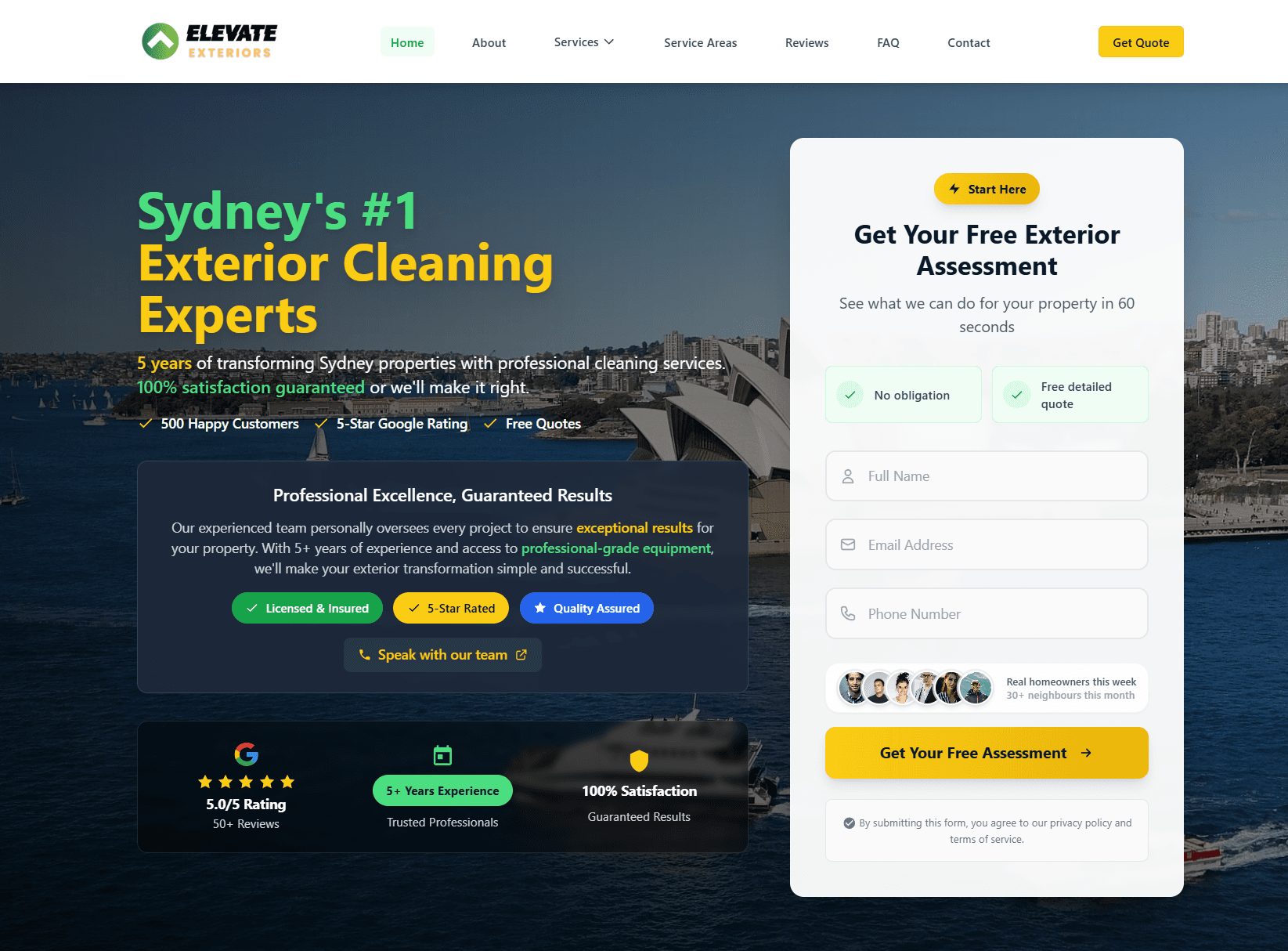
Real client. Real results.
Elevate ExteriorsExterior Services
Website rebuild + SEO foundations. After a 4 to 6 month build phase, now generating 15 to 20 qualified leads per month from organic search. No ad spend, lead quality consistently higher than paid traffic.
Quick answers
Frequently asked questions
Tagged with
Written by
Guru, Founder at Vynlox
Sydney based · 8+ years building websites · 100% client retention
I started Vynlox after watching too many good Australian businesses get burned by agencies that send reports, not results. Every strategy call you book is with me directly. You won't be handed off to a junior. You work with me.


