

Guru
Founder, Vynlox
Most Australian businesses thinking about buying Google reviews want a shortcut. They have 6 reviews while their competitor has 80. They want to compete tomorrow, not in 12 months. The math on the shortcut looks easy. The math on the consequences does not. Buying Google reviews is illegal in Australia, Google detects it, and the recovery cost is brutal when (not if) you get caught.
If you want to grow a real review base without the legal exposure, request a free SEO audit and we will set up a review system that produces real reviews on a schedule.
What "buying reviews" actually means
Free SEO audit · No obligation
Curious how your site ranks today?
We'll audit your current SEO, identify the biggest opportunities, and send the report. Free, no obligation.
Get a Free SEO AuditThe shortcut industry sells reviews in three packages. Cash-for-reviews services where you pay $5 to $20 per fake 5-star review (often from offshore review farms). Incentivised reviews where you give customers a discount, gift, or competition entry in exchange for a 5-star rating. And review-gating, where you ask happy customers for a public review and direct unhappy customers to private feedback.
All three are illegal in Australia. The Australian Consumer Law (ACL) treats fake or incentivised reviews as misleading and deceptive conduct. The ACCC has been actively enforcing this since 2019 and has accelerated enforcement through 2024 and 2025.
What the ACCC actually does (and the penalties are not theoretical)
The ACCC has obtained court orders, issued infringement notices, and forced public corrections across multiple industries. Penalties for businesses caught buying or incentivising reviews can hit $50,000+ per individual involved and $250,000+ per corporation. There is also reputational damage when the ACCC publishes the enforcement decision (those press releases sit on Google forever).
Beyond the legal penalties, Google has its own consequences. Algorithmic detection has improved dramatically. Profiles caught with fake review patterns can lose all their reviews (legitimate AND fake), get demoted in the Map pack, or be suspended entirely. Recovery from a suspension takes months and is not guaranteed.

How Google detects fake reviews
Five signals trigger Google's algorithm:
- Velocity spike. A profile that historically gained 2 reviews per month suddenly gaining 30 in two weeks is flagged automatically.
- Reviewer account patterns. Brand-new Gmail accounts that leave one 5-star review and never review anything else are statistical outliers.
- IP address clustering. Reviews coming from the same data centre or VPN cluster get flagged.
- Review content. Generic praise without specific details ("great service, highly recommend") versus real customer language that mentions staff names, specific services, and real friction.
- Temporal patterns. All reviews arriving between 2 and 4 AM local time is a synthetic signal.
The math: shortcut vs the legitimate path
| Path | Upfront cost | Time to ranking impact | Risk of detection | If caught (cost) | Long-term durability |
|---|---|---|---|---|---|
| Buy reviews | $500 to $5,000 | 2 to 6 weeks | High and rising | $30,000 to $250,000+ in penalties + suspended profile + months of rebuilding | Zero (the asset is fragile) |
| Build legitimate review system | $0 to $2,000 (system setup) | 3 to 6 months | Zero | Zero | Compounding (real reviews keep producing forever) |
The shortcut path looks faster on the spreadsheet. It is slower on the actual business outcome because it ends in a suspension or penalty in most cases.
The legitimate review system that actually works
Five components. Each one matters; skip any and the system underperforms.
1. Ask every paying customer
The single biggest unlock. Most businesses ask 5 to 10 percent of customers for a review. Successful ones ask 95 percent. Build the ask into your post-sale workflow as a non-optional step.
2. Time the ask correctly
Within 24 to 72 hours of the job completing. Customer is satisfied, the experience is fresh, and they are most likely to act. Asking 6 months later is asking too late.
3. Use a direct link, not a landing page
Send customers straight to your Google Business Profile review form. Every extra click halves your conversion rate. A QR code on your invoice or van that links straight to the review form is the gold standard.
4. Reply to every review
Including the negative ones. Especially the negative ones. Google reads your replies as a ranking signal, and a measured, professional reply to a 1-star review converts more comparison-shopping customers than any 5-star review ever will.
5. Make it part of your ongoing marketing rhythm
Not a one-off campaign. A monthly check-in: how many reviews did we get this month, what is the average, who has not been asked yet. Treat reviews like leads: tracked, measured, optimised.
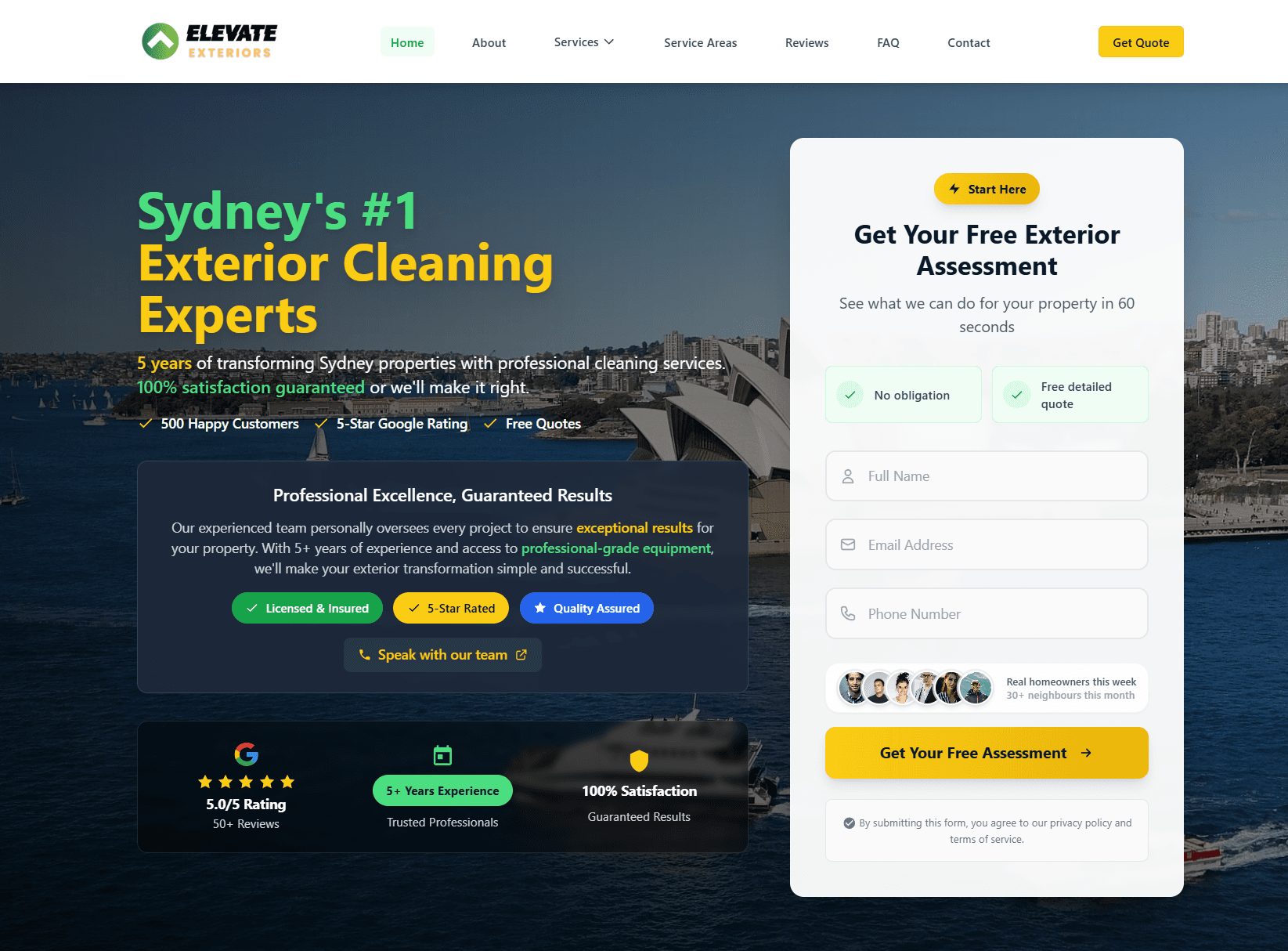
This is exactly the system we set up for RyRo Loan Centre (visit them at ryroloancentre.com.au). Combined with their broader 3-channel approach (organic + GBP + AI search), they hit 22 qualified leads in 90 days at $0 ad spend. Same playbook works for Elevate Exteriors (visit them at elevate-exteriors.com.au) who now run at a current floor of 15 to 20 qualified leads per month from organic and growing.

Why review velocity matters more than total review count
Google's local algorithm weighs RECENT reviews more than total volume. A profile with 30 reviews from the last 6 months outranks a profile with 100 reviews from 2020. This is good news if you are starting from a low base: you do not have to match a competitor's lifetime review count, you just have to outpace them in velocity.
Practical implication: a plumber with 10 reviews this quarter beats a competitor with 80 reviews from 4 years ago who hasn't asked for one in 12 months. The dormant 80-review profile is rotting in Google's eyes; the active 10-review profile is rising.
This is the same dynamic we cover for tradies in our SEO playbook for plumbers and the underlying mechanic in our Google Business Profile guide.
Why a legitimate system pairs perfectly with our SEO retainer
Reviews are one of the top three Map pack ranking signals (alongside categories and proximity). Our SEO retainer treats review velocity as a core deliverable, not an afterthought. We set up the system, run the post-job follow-up automation, train your team, and report monthly on review velocity, average rating, response rate, and the resulting Map pack rank movements.
For service businesses that also need a website rebuild, we package this with our website design service so the review-collection workflow is built into the site from day one (QR codes, follow-up email automation, review widgets). That is how reviews compound into rankings into leads.

Real client. Real results.
Elevate ExteriorsExterior Services
Website rebuild + SEO foundations. After a 4 to 6 month build phase, now generating 15 to 20 qualified leads per month from organic search. No ad spend, lead quality consistently higher than paid traffic.
Quick answers
Frequently asked questions
Tagged with
Written by
Guru, Founder at Vynlox
Sydney based · 8+ years building websites · 100% client retention
I started Vynlox after watching too many good Australian businesses get burned by agencies that send reports, not results. Every strategy call you book is with me directly. You won't be handed off to a junior. You work with me.


