

Guru
Founder, Vynlox
Most Australian service businesses leave money on the table every month because their Google Business Profile (GBP) is half-set-up, untouched since 2023, or has the wrong opening hours posted. New customers arrive through luck, referrals, or paid clicks that stop the moment the budget runs out, while the single highest-ROI free marketing asset they own sits broken in the background.
That is a problem. It is also an opportunity. A properly-managed GBP gets you in the Google Map pack for "[service] [suburb]" searches, sends warm calls and direction requests directly to your business, and feeds AI search engines like ChatGPT and Perplexity that increasingly cite local results. If you want this assessed for your business, request a free SEO audit and we will show you where your profile stands today.
What Google Business Profile actually is in 2026
Free SEO audit · No obligation
Curious how your site ranks today?
We'll audit your current SEO, identify the biggest opportunities, and send the report. Free, no obligation.
Get a Free SEO AuditYour Google Business Profile is the listing that appears when somebody searches your business name, your service plus a suburb, or "near me" queries. It controls whether you appear in the Map pack (top three local results with the map), what photos show up, what hours are displayed, what reviews are visible, and which AI search engines cite you when answering questions about local businesses.
Google retired the standalone "Google My Business" app in mid-2024 and moved everything into Google Search and Google Maps directly. To manage your profile in 2026, you sign in to Google with your business account, search your business name in Google Search or Maps, and the management dashboard appears inline with the listing. There is no separate dashboard URL, no separate app to download. This change confused a lot of business owners who looked for the GMB app, did not find it, and assumed Google had killed the product. The product is alive and more important than ever.

Why GBP is the highest-ROI asset most businesses ignore
GBP is free, it controls Map pack ranking, and most businesses run it on default settings. That combination means small effort produces outsized returns. We saw this with RyRo Loan Centre (visit them at ryroloancentre.com.au): the GBP was one of three lead channels we built in parallel (with organic SEO and AI search). It was their most consistent lead source within the first 30 days, before SEO had even started ranking. The same pattern plays out across local service businesses.
The math: a Map pack click is free. A Google Ads click for the same query routinely costs $5 to $50 depending on your niche. Multiply that by every "[service] near me" search where your profile appears in the top 3 versus the top 30 and the savings compound monthly.
The 7-step GBP optimisation playbook
Build these in order. Each layer reinforces the next.
1. Claim and verify your profile
If you have not claimed it, search your business in Google Maps. There may already be a listing Google auto-generated. Click "Claim this business" and follow the verification flow. Verification options include video verification (you record yourself near the business signage), postcard (Google mails a code, takes 5 to 10 days in Australia), and phone (instant for some categories). Choose the fastest available.
Once verified, you own it. No one else can edit your hours, add fake photos, or post misleading content.
2. Lock in primary and secondary categories
Your primary category is the single biggest ranking factor in Map pack. Choose precisely. A plumber should be "Plumber", not "Plumbing service". A dentist should be "Dentist", not "Dental clinic". Then add up to 9 secondary categories that genuinely apply: "Emergency plumber", "Gas plumber", "Hot water system supplier" for a plumber. Adding categories you do not service is a fast path to a Google suspension.
3. Service area, hours, and contact details
If you serve customers at their location (most tradies, mobile services), set your business as "service-area" and list every suburb you cover. If you have a physical premises, set it as a storefront with the address. List every service you provide, individually, with descriptions. Update your hours quarterly, and especially around public holidays. Wrong hours cost calls.
4. Photo and video strategy
Profiles with active photo uploads consistently outrank profiles with no recent photos. Upload 10 to 20 photos at first: vans, jobs, team, premises, before-and-after where applicable. Then continue adding 2 to 5 fresh photos every fortnight. Generic stock images do not perform. Real photos from your business do. Video is increasingly important: a 30-second team intro or job walkthrough often gets more engagement than any single photo.
5. Reviews and review velocity
Reviews are the second-biggest Map pack ranking factor after categories. Recency, volume, and average rating all matter. The fastest path to consistent reviews is a follow-up SMS or email two days after the job completes, with a direct GBP review link. Businesses running this system get 5 to 15 reviews per month consistently. Businesses hoping for reviews get 5 to 15 per year.
6. Google Posts (the underused weapon)
Google Posts are short updates that appear on your GBP profile. They cycle off after 7 days but tell Google your profile is active. Aim for 1 to 2 posts per week. Examples that work: a recent job, a seasonal offer, a piece of educational content, a team milestone. Skip the corporate "we provide quality service" posts. They produce nothing.
7. Q&A, products, and services modules
Most profiles have empty Q&A sections. Add 5 to 10 frequently-asked questions yourself with clear answers. The "Services" module lets you list every service line individually. The "Products" module is useful even for service businesses (list a flagship offering with pricing or "from $X").

GBP vs website SEO vs Google Ads: which to focus on first
| Channel | Setup cost | Time to first leads | Cost per lead | Best for |
|---|---|---|---|---|
| GBP | Free, ~2 hours setup | 2 to 6 weeks | $0 (free clicks) | Local service businesses with physical or service area |
| Website SEO | $2,500+ a month retainer | 3 to 6 months | Falls over time | Long-term defensible asset |
| Google Ads | Variable, $1,000+ a month | Day one | Stays high | Filling gaps, urgent jobs |
For most local Australian service businesses, the right sequence is: GBP first (cheapest, fastest, highest ROI), then layer website SEO, then add Ads to fill any remaining pipeline gaps. We use this sequencing across our SEO retainer engagements. Same logic in our complete dental SEO guide and our SEO playbook for plumbers.
How to measure GBP performance
The metrics that matter, all visible in the GBP insights dashboard:
- Phone calls from your profile (split by Map vs Search).
- Direction requests.
- Website clicks from the profile.
- Photo views (a leading indicator of profile health).
- Search queries triggering your profile.
If you are getting Map pack visibility but no phone calls, your photos or reviews need work. If you are getting calls but the close rate is low, your services list and category are sending the wrong signal about what you do. Treat the dashboard as a weekly check-in, not a quarterly afterthought.

Common mistakes that cost businesses Map pack rankings
Six classic GBP mistakes we fix every week:
- Wrong primary category. "Plumbing service" instead of "Plumber". Costs Map pack visibility immediately.
- Stuffed business name. Adding keywords like "Joe's Plumbing - Sydney Emergency" to the name is a violation. Google can suspend the profile or demote it.
- Service area too wide. Listing 50 suburbs in a 1-truck operation. Google penalises overreach. List the suburbs you genuinely service same-day.
- No new photos in 3+ months. The algorithm reads inactive profiles as low quality.
- Unanswered reviews. Especially negative ones. Future customers read these.
- Inconsistent NAP (Name, Address, Phone) across the website, GBP, and other directories. Confuses Google about whether you are a real business. Fix during a website rebuild and citation cleanup.
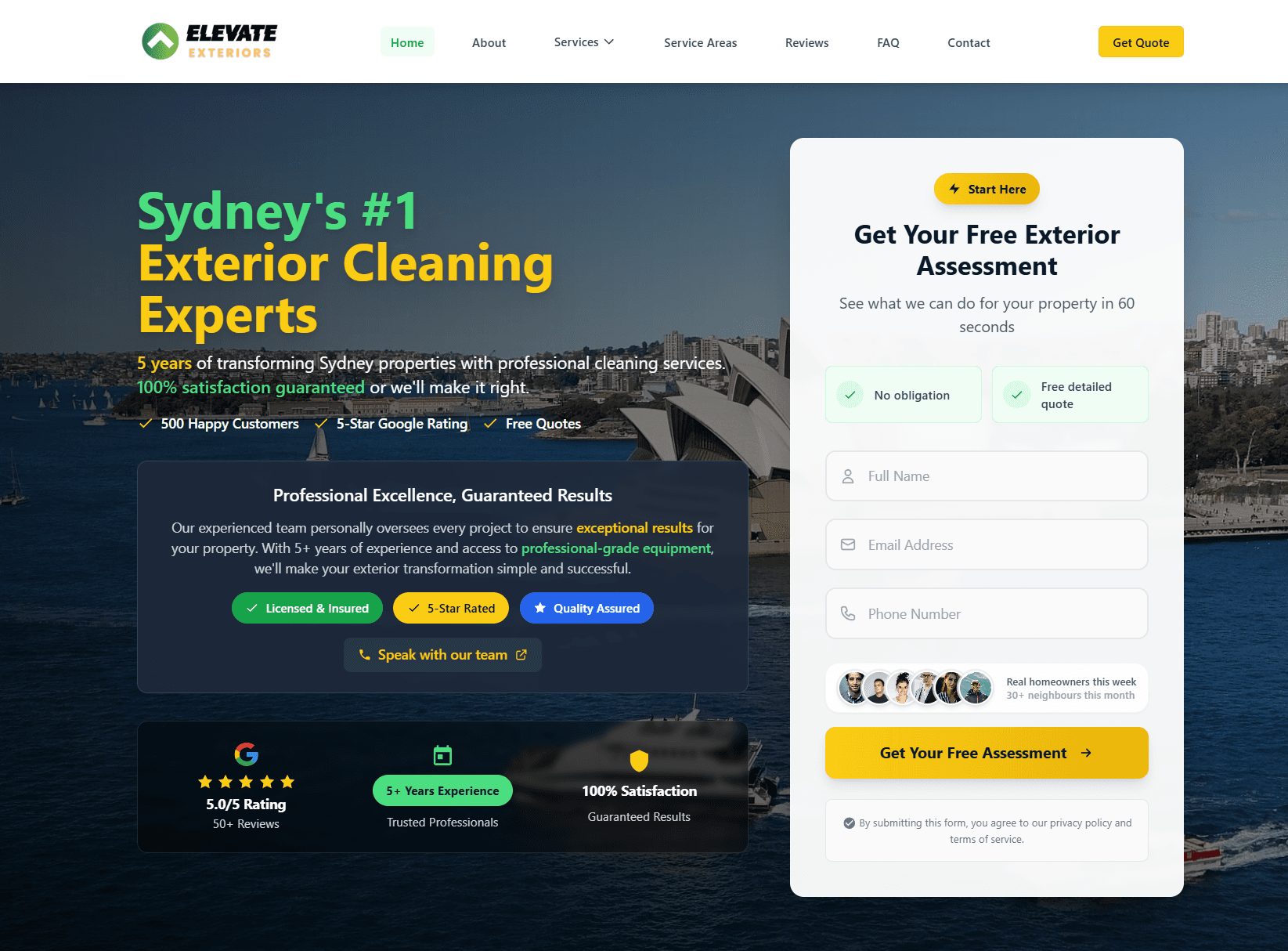
Real client. Real results.
Elevate ExteriorsExterior Services
Website rebuild + SEO foundations. After a 4 to 6 month build phase, now generating 15 to 20 qualified leads per month from organic search. No ad spend, lead quality consistently higher than paid traffic.
Quick answers
Frequently asked questions
Tagged with
Written by
Guru, Founder at Vynlox
Sydney based · 8+ years building websites · 100% client retention
I started Vynlox after watching too many good Australian businesses get burned by agencies that send reports, not results. Every strategy call you book is with me directly. You won't be handed off to a junior. You work with me.


