

Guru
Founder, Vynlox
Every Australian small business owner has been told SEO is "expensive marketing" by an agency, an accountant, or a sceptical co-founder. That framing is wrong, and it is the single biggest reason most service businesses end up renting their leads from Google Ads and Hipages forever instead of owning them.
SEO done right is not an expense. It is an asset that compounds in value every month it is in the ground. Cut your retainer next month and the asset keeps producing leads for the next 6 to 18 months. Cut your Google Ads budget next month and the leads stop tomorrow. That is the entire difference, in one sentence, and it changes how you should think about every dollar of your marketing spend.
If you want this assessed honestly for your business, request a free SEO audit and we will tell you whether SEO is genuinely an asset for your specific situation or just an expense in disguise.
Free SEO audit · No obligation
Curious how your site ranks today?
We'll audit your current SEO, identify the biggest opportunities, and send the report. Free, no obligation.
Get a Free SEO AuditThe asset vs expense framing in plain language
Accounting language helps. An expense is money spent that disappears the moment you spend it (rent, ad spend, agency hourly fees). An asset is money spent that produces ongoing returns and often appreciates (a delivery van, a piece of software you own, a brand). The same dollar spent on the same work can be either, depending on whether the work compounds or evaporates.
Google Ads is an expense by structure. You pay per click, the click ends, the lead either closes or does not, and tomorrow you start at zero again. There is no asset created, no equity built, no value retained. Stop spending and the leads stop the same day.
SEO done correctly is an asset by structure. You build a website that ranks, fill it with content that earns long-tail searches, accumulate backlinks that signal authority, and stack reviews that prove the business is real. Each piece of work compounds on the next. Stop investing in month 12 and the rankings continue producing for 6 to 18 months while the asset slowly depreciates. The exit is graceful, not catastrophic.

The honest math: $4,500 a month over 24 months
Pick a comparable budget. $4,500 a month for either an SEO retainer or paid ads for an Australian local service business in 2026. Both options run for 24 months. Same total spend ($108,000 over the period). What does each produce?
| Channel | Months 1 to 6 | Months 7 to 12 | Months 13 to 18 | Months 19 to 24 | What you own at month 25 |
|---|---|---|---|---|---|
| Google Ads | Same volume of leads each month from day one. ~10 to 15 leads/mo, falling slightly as competition rises. | Same volume, possibly fewer due to rising CPCs. | Same volume, costs continue rising. | Same volume. | Nothing. Stop spending = stop leads. |
| SEO | 0 to 3 leads. Foundation phase. | 5 to 10 leads. First page-1 rankings appear. | 12 to 20 leads. Compounding kicks in. | 18 to 25 leads. Asset matures. | Rankings, traffic, brand authority. Stop spending = leads continue for 6 to 18 months while gradually decaying. |
Total leads over 24 months: paid roughly 250-300, SEO roughly 250-380. Roughly comparable on raw count. But what you OWN at the end is the entire difference. The paid agency walks away with $108,000 of revenue and you walk away with nothing. The SEO investment leaves you with a ranking asset that produces 18 to 25 leads a month indefinitely, with maintenance costs typically halving by year 3.
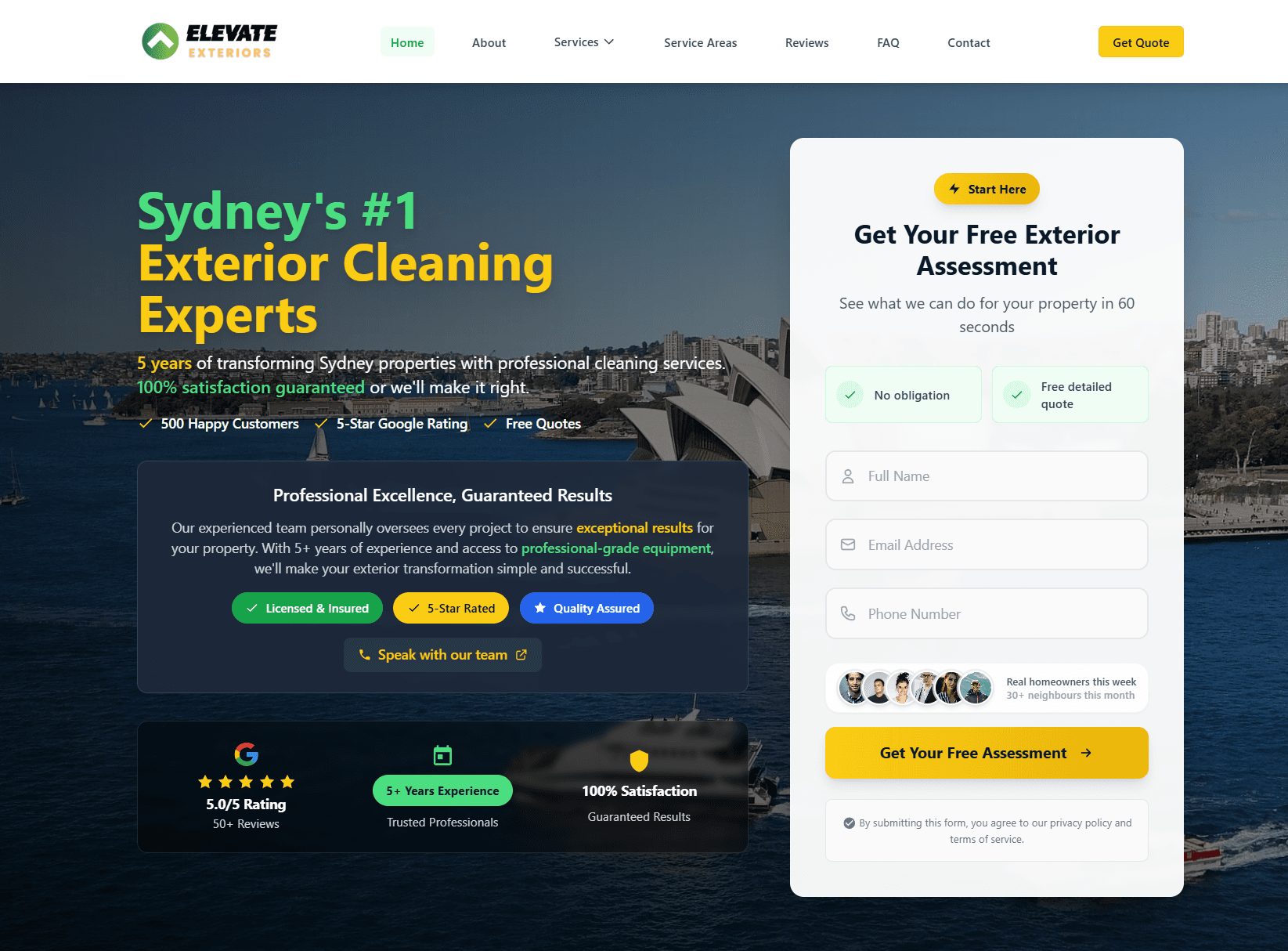
We saw this play out exactly with Elevate Exteriors (visit them at elevate-exteriors.com.au). A site rebuild plus SEO foundations took 4 to 6 months to mature, then they have been at a current floor of 15 to 20 qualified leads per month from organic and the curve is still climbing as authority compounds, with zero ad spend required to sustain it. The same compounding pattern shows up for RyRo Loan Centre (visit them at ryroloancentre.com.au). 22 qualified leads in 90 days at $0 ad spend, then a steady-state floor of 15 to 20 qualified leads per month from organic plus AI search referrals, with the curve still climbing. We covered the time-to-results detail in our timeline guide.
The three layers of asset value SEO actually creates
Most owners think SEO equals "more clicks". The asset is bigger than that.
1. Direct lead flow (the obvious layer)
Rankings produce clicks. Clicks produce form fills and phone calls. Form fills and phone calls produce closed customers. This is the layer everyone counts.
2. Defensive moat (the layer most miss)
Once you rank for "[your service] [your suburb]" type queries, displacing you takes a competitor 12 to 18 months of focused work. While they are working, you keep collecting leads. Even if a better-capitalised competitor enters, they cannot just buy your position. They have to earn it the same way you did. This is real competitive advantage.
3. AI search and brand authority (the emerging layer)
ChatGPT, Perplexity, Claude, and Google AI Overviews all increasingly cite businesses with established domain authority and ranking presence. The site you build for SEO is also the foundation for AEO. The third compounding layer (which we cover in detail under our Answer Engine Optimisation service) is brand presence in AI search results that will only grow more important through 2026 and 2027.
The asset value is all three layers stacked. The expense framing only counts the first one.
When SEO IS genuinely an expense (the honest part)
To be clear, SEO can be an expense and frequently is when run badly. If any of these are true, what you have is not an asset:
- You hired a content mill that publishes 4 generic posts a month and calls it SEO.
- You measured success in keyword count or "ranked for X terms" without tying back to leads or revenue.
- You quit at month 4 because the leads had not arrived. The build was wasted.
- Your business is genuinely in a niche with no search demand. SEO cannot manufacture demand.
- Your website is broken at the foundation level (slow, no schema, no service pages) and traffic gets sent to a leaky bucket.
In any of these cases, you are running SEO as an expense, paying for activity instead of building an asset. The work compounds on nothing.

What asset-first SEO actually looks like in practice
Three things separate an asset-building program from an expense-disguised-as-SEO.
First, a website that converts. Rankings are useless if the visitors land on a leaky bucket. We do not start an SEO retainer for clients with a broken site; we run our website design service first or in parallel.
Second, content velocity that builds topical authority. Not 1 generic post a month. 4 to 8 well-researched, internally linked, schema-marked pieces a month that compound into topic clusters. Each piece reinforces the next.
Third, monthly reporting on lead-impact metrics, not vanity metrics. Calls, form fills, MQLs, customers attributed to organic. Not "we ranked for 47 keywords this month". If your agency cannot tell you the dollar value of leads produced by organic last quarter, they are running SEO as an expense.

Real client. Real results.
Elevate ExteriorsExterior Services
Website rebuild + SEO foundations. After a 4 to 6 month build phase, now generating 15 to 20 qualified leads per month from organic search. No ad spend, lead quality consistently higher than paid traffic.
Quick answers
Frequently asked questions
Tagged with
Written by
Guru, Founder at Vynlox
Sydney based · 8+ years building websites · 100% client retention
I started Vynlox after watching too many good Australian businesses get burned by agencies that send reports, not results. Every strategy call you book is with me directly. You won't be handed off to a junior. You work with me.


