


Guru
Founder, Vynlox
Most law firms in Australia spend $5,000 to $15,000 per month on SEO that doesn't work. Their website sits broken in the background. Local search is tanked. Practice-area pages barely rank. New enquiries arrive through referrals, word of mouth, or paid clicks that stop the moment the budget runs out. That's a problem. It's also an opportunity. SEO done right gives law firms a compounding advantage. Enquiries arrive because potential clients found you ranked above competitors on Google. That asset keeps working for years with proper maintenance. If you want this done for you, get a free proposal.
What SEO services for law firms actually cover
SEO for law firms is different from SEO for tradies or accountants. You're competing on intent keywords ("personal injury lawyer Sydney", "family law advice", "commercial disputes Melbourne") where a single enquiry is worth thousands of dollars. You need service pages that speak to each practice area, local ranking authority, and trust signals that make prospects confident enough to call.
Free SEO audit · No obligation
Curious how your site ranks today?
We'll audit your current SEO, identify the biggest opportunities, and send the report. Free, no obligation.
Get a Free SEO AuditThis is not about blog content volume or keyword stuffing. It's about making Google understand which practice areas you serve, which suburbs you cover, and why clients should call you instead of the firm down the street. Our SEO retainer starts with a full technical audit of your site: crawl errors, page speed, indexation problems, broken redirects. Most law firm websites have at least 20 to 30 fixable issues that hurt rankings.
Once the foundation is solid, the playbook focuses on practice-area authority. If you're a family law firm, every practice-area page (separation, property division, custody, child support) needs to target specific keyword clusters and point back to your GMB profile and core service pages. Google wants to see topical depth and internal link structure that proves you're an expert in family law, not a generalist.
Local SEO matters enormously for law firms. Your Google Business Profile (if you have one) is your second-strongest ranking signal after backlinks. The profile needs consistent details (address, phone, service hours), client photos, and posts that update regularly. Most law firms neglect this. It costs nothing but attention.
What you don't need
Not every law firm needs every service. You don't need a content mill churning out 50 blog posts per year. You don't need keyword-stuffed landing pages. You don't need an "SEO expert" who charges setup fees, link-building fees, or "premium reporting" as add-ons.
You need:
- Technical foundation. Crawlable site, fast pages, proper schema markup, mobile responsive. This is table stakes.
- Practice-area clarity. Each practice area has its own page with relevant keywords, case outcomes (anonymized), and calls-to-action.
- Local presence. GMB profile optimized, consistent NAP (name, address, phone), client reviews invited.
- Proof. Case studies, client testimonials, trust badges that tell prospects you've solved problems like theirs.
Anything else is distraction. Most agencies sell this as a package ("we do SEO") when really they should be saying, "Here's exactly what we're fixing and why it matters to your firm."

The playbook: how law firm SEO actually works
This is the same approach we use for the dental SEO guide because the fundamentals transfer across professional services.
1. Technical foundation and site audit
Start here. Every law firm site has crawl errors, redirect chains, or pages that don't index properly. Run a technical audit (we recommend Semrush or Ahrefs; Google Search Console is free and tells you the worst offenders). Fix these in order:
- XML sitemap is submitted and up to date
- robots.txt allows crawling
- Canonicals are set correctly (no duplicate content penalties)
- Page speed on mobile (under 3 seconds load time)
- Mobile responsive (Google's mobile-first index cares about this first)
- Schema markup (LocalBusiness for your firm, BreadcrumbList for navigation)
This usually takes 4 to 8 weeks depending on site size. You'll see ranking bumps even before you add new content because you've removed barriers to crawling and indexing.
2. Practice-area page structure
Each practice area gets its own page. "Family Law" is too broad. Instead, create:
- Separation and divorce
- Property division
- Custody and parenting
- Child support
- De facto relationships
Each page targets 8 to 12 related keywords and explains what you do in plain language (no legal jargon unless necessary). Link each practice-area page back to your homepage and GMB profile. Link them to each other where relevant (e.g., "If you're also dealing with property division, see our guide here").
Most law firms skip this step. They have a homepage that says "We do family law, criminal law, and commercial law" and expect Google to rank them for everything. That doesn't work. Be specific.
3. Local SEO and Google Business Profile
Claim and optimize your GMB profile if you haven't. Make sure:
- Name, address, phone are identical across your website, GMB, and directory listings (NAP consistency matters)
- Service areas are listed (suburbs you cover; courts you appear in)
- Category is "Law Firm" or "Lawyer" (not "Attorney" or "Legal Services")
- You have at least 20 client photos (you take these; GMB won't rank you without them)
- Posts are added every 2 weeks (case results, practice updates, firm announcements)
- You ask for and respond to all reviews (positive and negative)
This work is relentless but cheap. A 5-star review from a client costs nothing but a follow-up email asking them to leave feedback.
4. Content and topical authority
Only after the above is solid should you think about content. Write like the dental SEO playbook describes: address real questions your clients ask. A page titled "What happens in a separation?" gets more enquiries than "Separation law explained." Be specific, use numbers, show outcomes (anonymized).
You don't need to publish weekly. One strong 2,000-word page per quarter that addresses a pain point is better than 50 thin pages nobody reads. Each page should link back to your practice-area pages and CTAs ("If you're ready to start, get a free consultation").

Pricing: what law firm SEO costs
Expect this:
| Service level | Time to baseline | Monthly cost | Best for |
|---|---|---|---|
| Local SEO only | 4 to 8 weeks | $1,500 to $3,000 | Single-location firms, high local intent |
| Regional (3 to 5 suburbs) | 8 to 12 weeks | $3,500 to $6,000 | Multi-suburb practices, specific keywords |
| State-wide or practice-area focus | 12 to 16 weeks | $6,000 to $12,000+ | Large firms, competitive keywords, multiple practice areas |
These are Australian market rates. Anything under $1,500/month is probably a content mill. Anything over $15,000/month without a specific reason (massive national expansion, highly competitive keywords) is padding.
The timeline matters. If an agency promises top-3 rankings in 4 weeks, they're either lying or they're using tactics that Google will penalise later. Real SEO compounds over time. Month 1 is setup. Month 2 to 3 is data. Month 4+ is results.
How to spot a bad agency versus a good one
Bad agencies:
- Promise rankings without an audit
- Sell "content packages" before understanding your structure
- Don't ask about your competitors or practice areas
- Charge link-building or technical fees on top of retainer
- Can't explain why each tactic matters to law firms specifically
Good agencies:
- Start with a full audit and explain what's broken
- Ask about your competitor landscape and which practice areas drive most enquiries
- Build practice-area pages before writing any blog content
- Link everything back to measurable outcomes (enquiries, calls, form submissions)
- Give you direct access to the people doing the work (no account managers)
How to measure success
Don't measure "keywords ranked." Measure enquiries.
Ask your SEO partner:
- How many enquiries came through the website last month?
- Which practice area drove the most?
- What's the cost per enquiry compared to paid search?
- How many clients converted from that first enquiry?
If your partner can't answer these, they're not measuring the right things.
Most law firm websites don't track enquiries properly. You need forms that capture name, email, phone, and practice area. You need to tag which enquiries came from organic versus paid versus direct. Then you ask: "Did we close that client? What's the lifetime value?"
When you tie SEO to real revenue, it's easy to see why it's worth the investment. A single high-value client covers 6 months of SEO retainer cost.

This is why our SEO retainer and website design service work together for law firms. We saw the same pattern with RyRo Loan Centre (visit them at ryroloancentre.com.au): trust-heavy verticals win when search and site work compound.
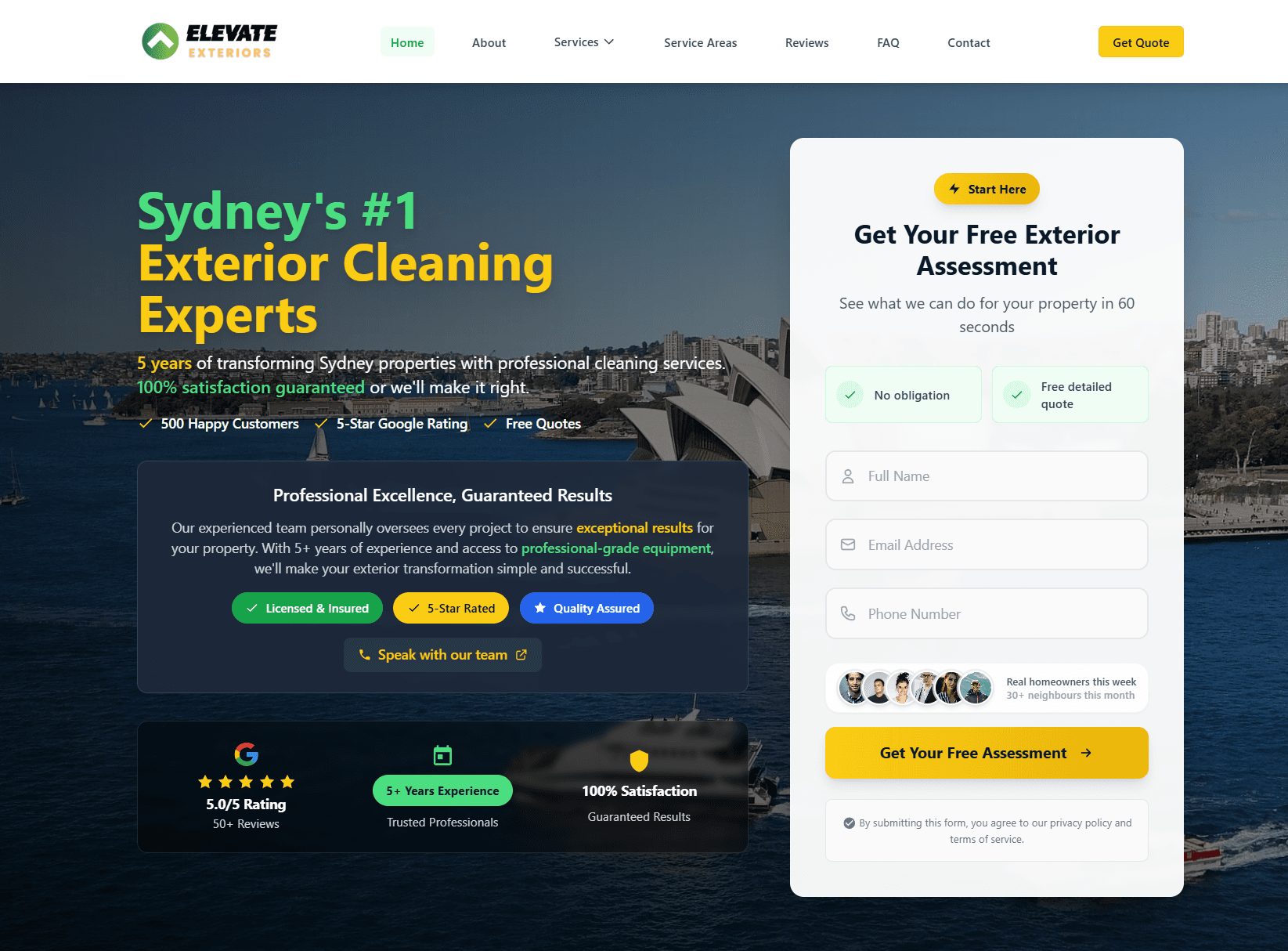
Real client. Real results.
Elevate ExteriorsExterior Services
Website rebuild + SEO foundations. After a 4 to 6 month build phase, now generating 15 to 20 qualified leads per month from organic search. No ad spend, lead quality consistently higher than paid traffic.
Quick answers
Frequently asked questions
Tagged with
Written by
Guru, Founder at Vynlox
Sydney based · 8+ years building websites · 100% client retention
I started Vynlox after watching too many good Australian businesses get burned by agencies that send reports, not results. Every strategy call you book is with me directly. You won't be handed off to a junior. You work with me.


