

Vynlox
Founder, Vynlox
Generative Engine Optimisation (GEO) is the practice of getting your business cited by AI search engines like ChatGPT, Perplexity, Claude, and Google AI Overviews. Here is the longer version with what most articles skip.
For the first time in 15 years, the way people search is changing. Ten years ago, you optimised for Google. Three years ago, you added TikTok and YouTube. Today, hundreds of thousands of Australians are asking questions to ChatGPT instead of typing them into Google Search.
And when they do, those AI models need to decide which businesses to cite as credible sources.
Free AI visibility check
Are you showing up in ChatGPT and Google AI?
We'll check whether AI search engines are recommending your business. Free, no obligation, results in 1 business day.
Get a Free AI Visibility CheckThat's where GEO comes in.
What Generative Engine Optimisation actually is
GEO is not a new form of SEO. It's not the same as Answer Engine Optimisation (AEO). It's a separate distribution channel for your expertise.
Here's the difference:
- SEO = optimising to rank on Google Search, Bing, or DuckDuckGo
- AEO = optimising to appear in Google AI Overviews, Bing's AI features, and other traditional search engine AI features
- GEO = optimising to be cited by standalone generative AI models like ChatGPT, Claude, Perplexity, and similar tools
When someone asks ChatGPT, "Where should I get my roof inspected in Sydney?", the model pulls from its training data and web results to answer. If your business is credible enough, cited enough, and relevant enough, ChatGPT will mention you by name.
That citation is a lead. Unlike an SEO ranking, you don't get repeated traffic from the same person. Each user of ChatGPT sees different results. But that doesn't make it less valuable. It makes it more valuable because the person who clicked your business name in ChatGPT is primed to convert.

Why GEO is different from what you already know
If you've invested in SEO or AEO, you're thinking: "Isn't this the same thing but for different search engines?"
Not exactly.
Google's algorithm ranks pages. ChatGPT's algorithm cites businesses. The distinction matters.
When you optimise for Google, you compete for a position. Fifty websites might rank for "roof inspection Sydney" and you might land position three. The person scrolling sees all fifty in the results.
When you optimise for ChatGPT citations, you're competing for credibility. The AI model picks three to five businesses to mention in its answer. Fewer slots. Harder to game. Much higher conversion.
This is exactly what we saw with RyRo Loan Centre (you can visit them at ryroloancentre.com.au), a home loan broker in Brisbane. Over 90 days, they captured 22 leads from ChatGPT referrals with zero ad spend. Those ChatGPT leads were consistently their highest-quality inbound channel across all three sources (Google Business Profile, organic, and AI search combined). Why? Because someone who found them via ChatGPT had already asked the AI for a recommendation. They weren't comparing 50 brokers. The AI had already filtered to the best.
That's the GEO opportunity.
Which AI engines matter for Australian businesses
Not all generative AI engines are equal for lead generation. Some have millions of Australian users. Some have almost none.
ChatGPT remains the biggest. Over 200 million active users globally, with a growing Australian base. Most Australian businesses should start here.
Perplexity is the second wave. Built for search, updated with real-time data, loved by researchers and students. Australian SMEs have found consistent referral traffic here.
Claude (Anthropic) is growing in the enterprise and professional services space. If you serve accountants, lawyers, or CTOs, Claude users are higher-intent than the general ChatGPT crowd.
Google AI Overviews in the search results themselves. Technically this is AEO, not pure GEO, but the citation patterns are similar enough to treat as one channel.
Gemini (Google's generative AI) is built into Android and being pushed hard, but Australian citation rates are still lower than ChatGPT or Perplexity.
Microsoft Copilot powers search on Bing with generative results. Lower volume, but real.
For most Australian businesses, focus on ChatGPT and Perplexity first. Build from there.
How AI engines decide what to cite
This is where GEO strategy lives.
AI models don't rank pages. They cite businesses or sources based on a combination of signals:
Freshness. ChatGPT's knowledge was trained on data up to April 2024. But Perplexity and Claude pull from the live web. If your content is recent, you're more likely to be cited.
Structured data and schema. FAQ schema, LocalBusiness schema, and BreadcrumbList schema all send clear signals about what your business does and where it operates. AI models read this first.
Third-party citations. Mentions of your business on trusted news sites, industry directories, and review platforms. If reputable sources mention you, the AI trusts you.
Brand mentions. How often your business name appears on the web. This is different from links. Pure mentions count.
Direct content relevance. Does your website answer the question the user asked? If someone asks ChatGPT about roof inspections and your page is a 2,000-word guide on roof inspection red flags, you're a citation candidate.
Authority and trust signals. Domain age, backlink profile, reviews, and social proof all matter. But differently than SEO. For GEO, authority matters less than relevance. A niche expert site with 50 backlinks can outrank a general contractor with 5,000.
| Signal | Impact on SEO ranking | Impact on GEO citation |
|---|---|---|
| Backlinks | High | Medium |
| Freshness | Medium | Very high |
| Brand mentions | Low | High |
| Schema markup | Medium | Very high |
| Direct relevance | High | High |
| Domain age | Medium | Low |
| Reviews | Low | Medium |
The 6-part GEO playbook
Most Australian businesses skip this because they don't know it exists. Here's the complete playbook.
1. Audit your existing citations across AI-readable sources.
Google your business name plus your suburb or service. Where do you appear? On industry directories? News sites? Third-party review platforms? These citations compound. More mentions on trusted sources means more likely AI models cite you.
2. Create GEO-optimised content on your website.
Write 1,500 to 3,000-word guides that answer the questions customers ask ChatGPT. If you're a dentist, write a post called "What Should I Do If I Have a Cracked Tooth?" with FAQ schema. If you're a tradies business, write about common problems and solutions in your area (e.g., "Why Are Sydney Timber Homes Getting Termites?").
The key: answer the question completely and credibly in the first 300 words. AI models cite sources that answer the user's question early and thoroughly.
3. Add FAQ schema to every relevant page.
This is the single highest-leverage GEO tactic. FAQ schema tells AI models that your page contains answers to common questions. ChatGPT and Perplexity reward this explicitly.
{
  "@context": "https://schema.org",
  "@type": "FAQPage",
  "mainEntity": [
    {
      "@type": "Question",
      "@id": "https://yoursite.com/#faq-1",
      "name": "What causes a cracked tooth?",
      "acceptedAnswer": {
        "@type": "Answer",
        "text": "Cracked teeth usually result from..."
      }
    }
  ]
}
4. Build third-party citations strategically.
Get mentioned on industry directories, chamber of commerce sites, and trade publications relevant to your niche. Every citation is a signal to AI models that you're credible.
5. Update your content regularly.
Freshness is critical for GEO. If you published a post three years ago, refresh it with current data, examples, and insights. Set a reminder to revisit top posts every 60 to 90 days.
6. Measure what actually works.
Set up a custom GA4 segment for ChatGPT and Perplexity referral traffic. Create a spreadsheet and log leads from each source monthly. This tells you where to double down.

How to track GEO performance in GA4
You can't optimise what you can't measure.
Set up a custom dimension for referral source. In GA4:
- Go to Data > Data Streams > Web.
- Add a custom event parameter called "ai_engine" with values: "chatgpt", "perplexity", "claude", "google-ai", "other".
- Create a custom segment for each engine.
- Build a report dashboard showing: sessions from each AI engine, bounce rate, average engagement time, conversion rate (form fill, call, purchase).
Track this monthly in a spreadsheet alongside your SEO and AEO metrics. Within three months you'll see which channels drive quality leads and which are still building.
Common mistakes that block GEO success
Mistake 1: Treating GEO the same as SEO.
You don't need 200 backlinks for a ChatGPT citation. You need fresh, credible, FAQ-rich content. Adjust your priorities.
Mistake 2: Ignoring freshness.
AI models reward recent content. If your guide is from 2022, refresh it. Add new data, case studies, and examples. Republish it so the timestamp updates.
Mistake 3: Forgetting FAQ schema.
This is the single easiest win. Most competitors are still ignoring it. Adding FAQ schema to 10 pages can generate citations within 60 to 90 days.
Mistake 4: No third-party citations.
You can't just live on your own domain. Build citations on directories, industry sites, and local listings. This compounds your credibility.
Mistake 5: Publishing and walking away.
GEO isn't a set-and-forget channel. Successful businesses treat their blog and content like a living asset. Refresh top posts every quarter.

Why now is the first-mover window
GEO is where SEO was in 2008. Google Search was real. Most businesses hadn't figured it out yet. The ones who did built a moat.
Today, ChatGPT has 200 million users and is growing. Perplexity is the fastest-growing search alternative in years. Claude is gaining ground in enterprise. But most Australian businesses still haven't published a single GEO-optimised page.
The businesses that move now will be cited consistently by the time competition catches up. By 2027, every competitor will be doing this. Right now, you have a window.
If you want to get ahead, the time is now.
This is exactly what we're helping our clients do with our Answer Engine Optimisation service. We audit which AI engines your customers are actually using, build GEO-optimised content on your website, add the schema, and measure the leads month by month.
The ROI is simple: ChatGPT referrals convert at a higher rate than most other channels because they're pre-qualified. If you're not capturing them, you're losing deals to competitors who are.
Most Australian businesses we work with combine GEO with our SEO retainer and our website design service so the foundation supports the AI-citation work. The compounding effect across all three channels is why we structured our Answer Engine Optimisation service the way we did. We covered the broader AI-search context in our Perplexity AI guide and the foundation playbook in our complete dental SEO guide.
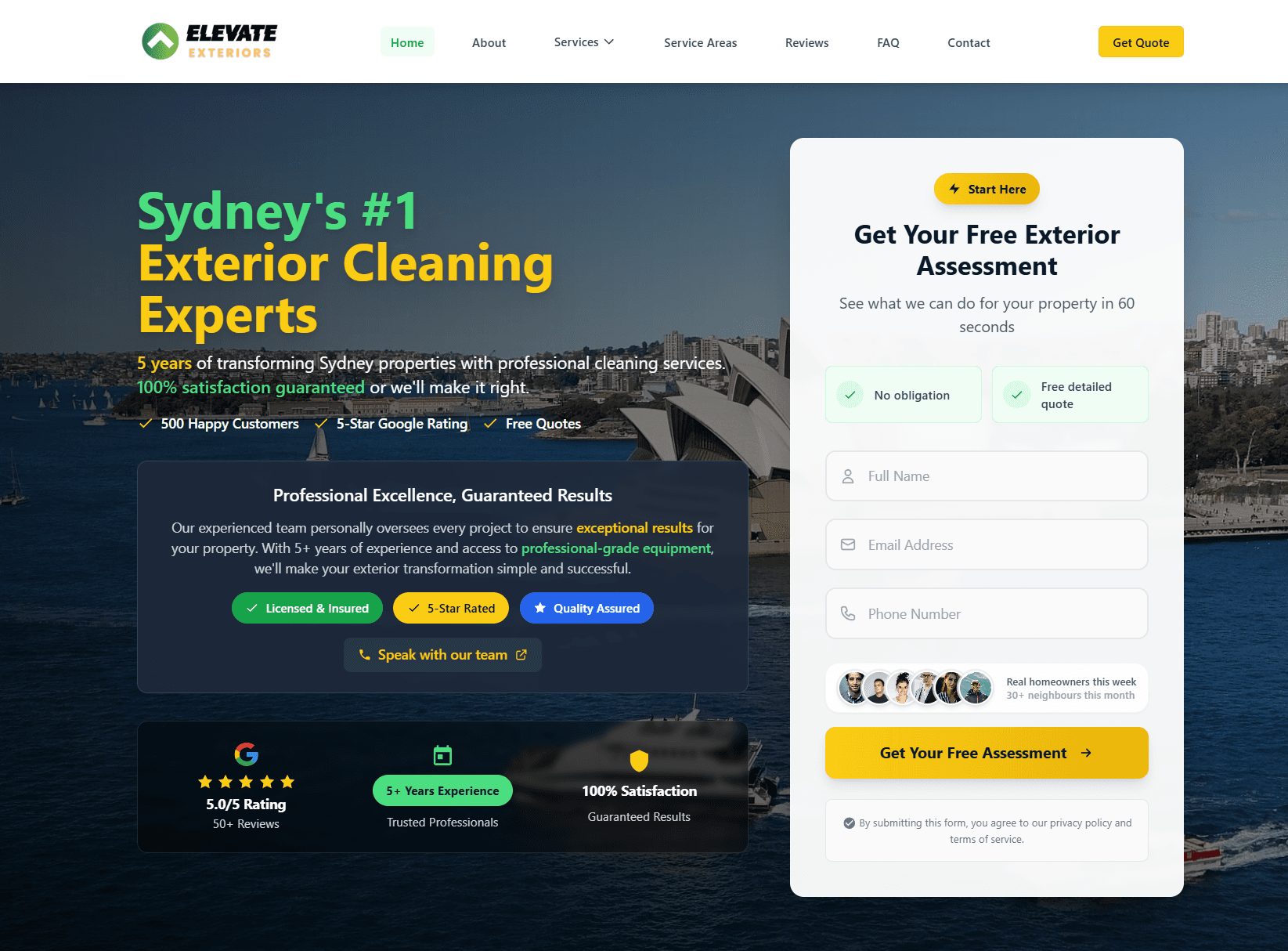
Real client. Real results.
Elevate ExteriorsExterior Services
Website rebuild + SEO foundations. After a 4 to 6 month build phase, now generating 15 to 20 qualified leads per month from organic search. No ad spend, lead quality consistently higher than paid traffic.
Quick answers
Frequently asked questions
Tagged with
Written by
Guru, Founder at Vynlox
Sydney based · 8+ years building websites · 100% client retention
I started Vynlox after watching too many good Australian businesses get burned by agencies that send reports, not results. Every strategy call you book is with me directly. You won't be handed off to a junior. You work with me.


